


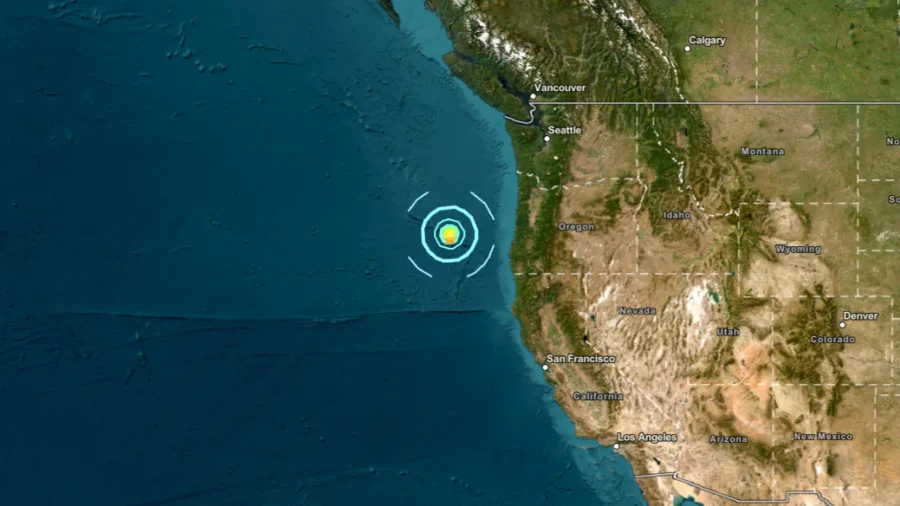
A magnitude 6.0 earthquake rattled the Oregon coast late Thursday, but officials said there was no risk of a tsunami and minimal impacts on land.
The quake struck at 7:25 p.m. PST, centered approximately 183 miles west of Bandon, Oregon, according to the U.S. Geological Survey (USGS). It occurred at a depth of 6.2 miles in the Blanco Fracture Zone, a seismically active area where the Juan de Fuca and Pacific tectonic plates interact.
Shaking was weak, reaching intensity 3 on the Modified Mercalli Intensity scale in some coastal spots.
According to the agency, the earthquake was most likely the potential mainshock of an earthquake sequence.
No damage has been reported so far.
Chances of a Megathrust Quake?
Researchers have predicted a 37 percent chance of a megathrust earthquake exceeding magnitude 7.1 in the Cascadia Subduction Zone within the next 50 years. That zone, a major offshore tectonic plate boundary stretching from Northern California to British Columbia, could produce devastating quakes and tsunamis.Thursday's event, however, was in the neighboring Blanco Fracture Zone and not indicative of an imminent Cascadia rupture.
In the study to explain the vent’s nature, researchers suggest that the liquid leaking out of the sea floor hole, which shoots up warm, mineral-rich liquid into the Pacific Ocean, may be acting as a lubricant between the oceanic and continental plates, and that less lubricant means more pressure accumulated to produce a devastating earthquake.
“The megathrust fault zone is like an air hockey table,” the professor explained. “If the fluid pressure is high, it’s like the air is turned on, meaning there’s less friction and the two plates can slip.”
“If the fluid pressure is lower, the two plates will lock,” he added. “That’s when stress can build up.”