

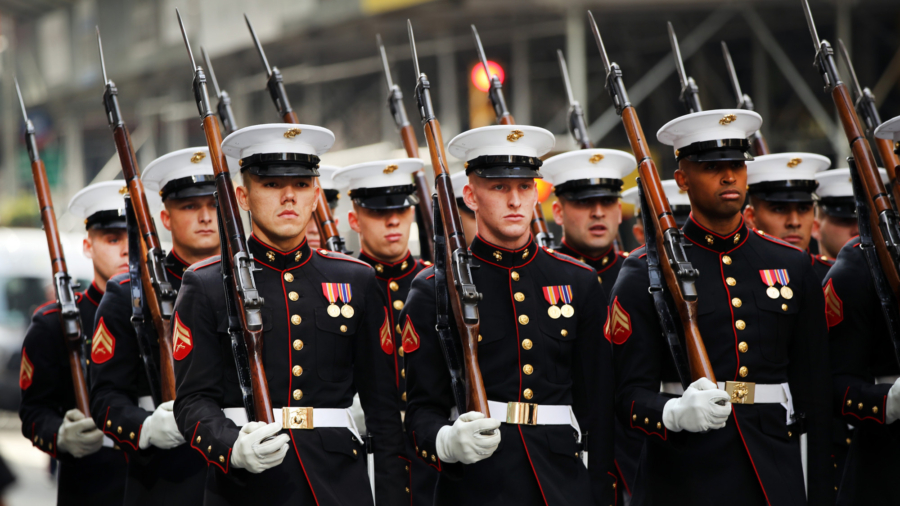
The United States Marine Corps is banning all instances of symbolism reflective of the Confederate battle flag in public view following the death of George Floyd.
In a message, the Marine Corps said that public displays would include but are not limited to public spaces like bumper stickers, clothing, mugs, posters, and flags.
The U.S. Marine Corps stated that the reason for the change is that the confederate flag had often been associated and co-opted by "violent extremists," as well as "racist groups" with "divisive beliefs." Furthermore, the Marines stated that these ideologies and actions have no place in the corps.
"Our history as a nation, and events like the violence in Charlottesville in 2017, highlight the divisiveness, the use of the confederate battle had on our society. This presents a threat to our core values, unit cohesion, security, and good order and discipline," the message read.
"Commanders must exercise best judgement and discretion consistent with this when conducting inspections," the message read. However, the message suggests consulting with their respective staff judge advocate when running across questionable situations.
According to the Marine Administrative Message, this directive applies to the total force.
However, it stated that this directive of removing the Confederate battle flag from Marine Corp Installations does not apply to some instances, namely, the National Museum of the Marine Corps, the Museum at the Marine Corps Recruit Depot (MCRD) San Diego, Parris Island, or any Marine Installation that "addresses the civil war from a neutral, historical, or educational perspective."

In addition, while performing inspections to remove instances of the Confederate battle flag, the message said that commanders are not allowed to look and search inside individually-assigned rooms or living quarters, desk drawers, cabinet drawers, lockers, bags, private automobiles, or housing that's owned or operated by the government.
However, places that can be searched and inspected include all workplaces and locations that are of common access to individuals. These include but are not limited to: office buildings, facilities, boats, vessels, aircrafts, government vehicles, hangars, ready rooms, conference rooms, individual offices, cubicles, storage rooms, tools and equipment rooms, workshops, break rooms, galleys, recreational areas, commissaries, Navy and Marine Corps exchanges, and heads.