


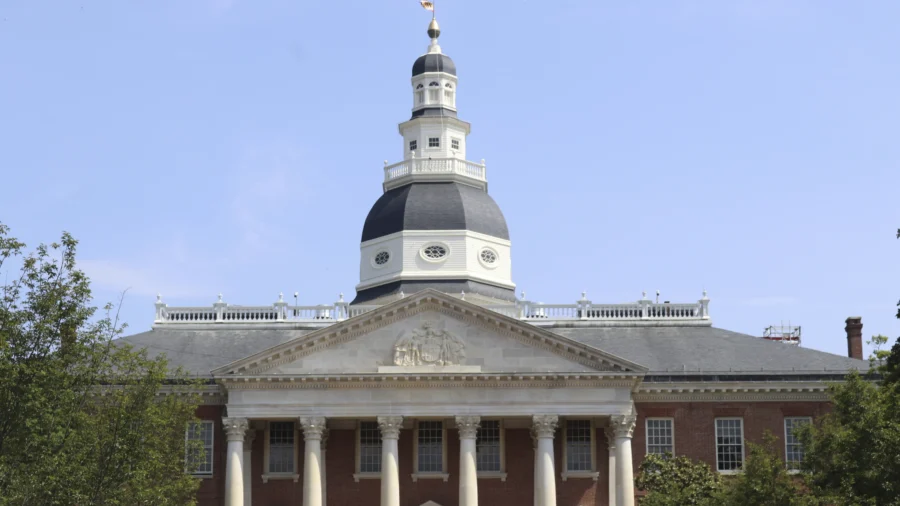
Maryland’s House of Delegates on Feb. 2 passed House Bill 488, advancing a plan to redraw the state’s congressional map ahead of the 2026 elections and sending the legislation to the Maryland Senate.
Democrats currently hold seven of Maryland’s eight U.S. House seats, and the proposed map could eliminate the state’s lone Republican-held district, represented by Rep. Andy Harris.
Republicans argue the bill was an attempt to eliminate the state’s last Republican congressional seat and said it would erode trust in elections and weaken representation of the Eastern Shore.
Del. Barry Beauchamp framed the proposal as inconsistent with the Democratic-controlled legislature’s frequent emphasis on inclusion.
“I look at diversity, equity, and inclusion, as being something that's spoken around here quite often,” he told state lawmakers. “How is this inclusive? How can you gerrymander the last seat and call this inclusive? To me, it's about fairness. And I oppose this bill. The minority party will have no representation if we allow this to pass.”
Del. Tom Hutchinson, also a Republican, said the bill was “disingenuous” and “partisan,” arguing lawmakers were moving quickly despite substantial opposition at hearings. He said following other states into mid-decade redistricting did not justify Maryland doing the same.
“Just because everybody’s doing it, it doesn’t make it right,” Hutchinson said.
Several Republicans also argued the bill was a distraction from state-level concerns, including affordability, energy costs, and education, and that Democrats were too focused on President Donald Trump and control of the U.S. House.
Democrats, meanwhile, argued the measure was a response to national developments and a way to strengthen Maryland’s ability to push back in Washington.
Del. Regina T. Boyce pointed to what she described as federal cuts and freezes affecting Maryland’s clean energy and infrastructure goals.
She cited revoked and paused grant funding, including support for renewable energy projects and flood mitigation, and said Maryland needed a congressional delegation positioned to protect those priorities.
“These federal cuts have created an uncertain future for Maryland’s environmental projects,” Boyce said, adding that was why she supported HB 488.
Other Democrats echoed a similar theme, arguing that Maryland’s economy—particularly its federal workforce—has been hit hard and that representation in Congress matters as federal policy shifts. Del. Melissa Wells cited Maryland job losses tied to the federal government and said the ripple effects extend statewide.
“This is about ensuring that states like Texas don’t get to make decisions for working Marylanders,” Wells said.
Many Democratic Delegates also framed the issue more broadly as a national struggle over power and accountability, arguing that mid-decade redistricting efforts in other states were designed to entrench control rather than reflect voters.
The bill now heads to the Maryland Senate, where it could face a more uncertain path even though Democrats control the chamber. Senate Majority Leader Bill Ferguson, a Democrat, has voiced opposition to mid-decade redistricting.
House Majority Leader David Moon, also a Democrat, has said he shares concerns about mid-decade redistricting in theory but argued the fix should be national rather than unilateral, saying Maryland should not limit itself while Republican-led states redraw maps. He pointed to a bill in the U.S. Congress—H.R. 4889—that would ban mid-decade redistricting in all 50 states and void maps drawn this cycle, arguing “the solution has to come from Congress.”
The bill’s synopsis says it would “alter districts for the election of Representatives in Congress for elections in 2026” and for elections held after that until a post-2030 census map takes effect.
The legislation also includes a ballot question framework tied to how long the proposed 2026 map could remain in place. Under the bill, a constitutional amendment would be submitted to voters at the November 2026 general election. The ballot language would authorize use of the map again for the 2028 and 2030 congressional elections until a new plan takes effect after the 2030 census.