


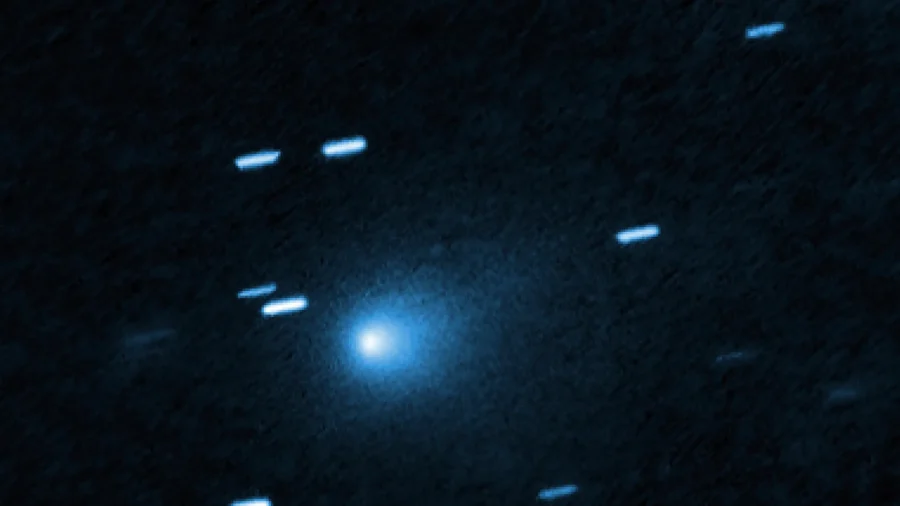
A newly discovered object speeding through the solar system from another star has sparked intrigue among astronomers worldwide.
“These things take millions of years to go from one stellar neighborhood to another, so this thing has likely been traveling through space for hundreds of millions of years, even billions of years,” Paul Chodas, director of NASA’s Center for Near Earth Object Studies, said Thursday. “We don’t know, and so we can’t predict which star it came from.”
NASA reported that 3I/ATLAS will make its closest approach to the sun in late October when it passes roughly 150 million miles from Earth. The object is expected to be visible by telescope through September, disappear behind the sun, and reappear in December on the other side.
Astronomers estimate the object’s core to be about 3.5 miles across, and it could even possibly be as little as 1,000 feet, based on Hubble’s latest observations.
“When I argued in an essay on July 20, 2025 that the prematurely claimed elongation in the images of 3I/ATLAS might be an artifact resulting from the motion of the object, I was attacked by bloggers who insisted that it represents evidence for a cometary tail,” he wrote. “Now that the dust has settled, literally speaking, we can ask again: could 3I/ATLAS be something other than a comet?”
Loeb introduced what he calls the "Loeb Scale," which ranks interstellar objects from 0 (definitely natural) to 10 (clearly artificial). He gave 3I/ATLAS a 6 out of 10, indicating that it might be an artificial object.
“It is difficult to forecast when and how a direct encounter with aliens would take place, even as we monitor 3I/ATLAS, because that involves many uncertainties regarding the alien travel technologies, goals and intent,” responded Loeb. “The best we can do is monitor the sky with telescopes,” adding that 3I/ATLAS may be a natural comet.
NASA has dismissed the idea that 3I/ATLAS is anything other than a natural comet, similar to the two previous interstellar visitors: Oumuamua in 2017 and 2I/Borisov in 2019.
“We’ve been expecting to see interstellar objects for decades, frankly, and finally we’re seeing them,” Chodas said. “A visitor from another solar system, even though it’s natural — it’s not artificial, don’t get excited because some people do ... It’s just very exciting.”
NASA says over 100 observations of 3I/ATLAS have already been logged. The object was about 277 million miles from Earth when Hubble captured its most recent image.