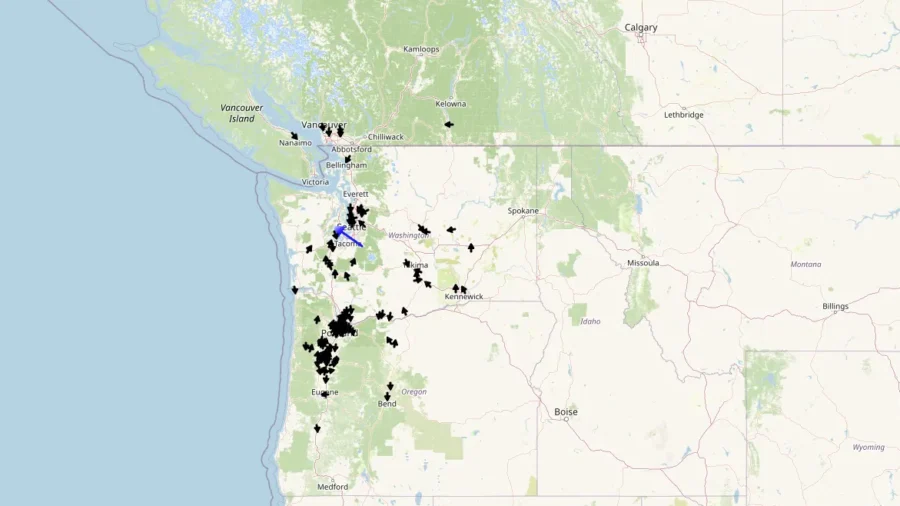
A bright fireball streaked across the night sky over the Pacific Northwest and Canada on March 28, prompting
confirmation from NASA.
“A fireball was observed by witnesses in the northwestern U.S. and Canada on the night of March 28,” NASA Space Alerts
posted on social media on March 30. “The fireball first became visible above the Washington town of Wilkeson. It moved northwest at 39,000 mph before disintegrating above Wauna.”
March has seen an uptick in fireball activity, with at least eight widely observed fireballs reported across the United States so far,
according to Phys.org.
“Texas, Ohio, California, Michigan—these are just a few of the states where folks have recently seen the skies illuminate with bright streaks of light,” NASA
said March 26.
Fireball sightings in March include in Ohio and Pennsylvania, where observers noted a daytime meteor that produced a sonic boom over
Medina County, Ohio, on March 17, and another visible across Michigan, Ohio, Indiana, Wisconsin, and into Ontario on
March 24.
In the Pacific Northwest, a bright green fireball was seen on March 23, followed by the one on March 28 over Washington, Oregon and British Columbia.
Green fireballs were reported over California on March 19 and March 22. Residents in East
Texas also captured video of a meteor on March 21.
Multiple fireballs were reported in Michigan, including one on March 20, bringing the state’s total to four sightings in one week.
Peak 'Fireball Season'
NASA officials said the event is part of the annual peak "fireball season," which runs from February through April. During this time, the number of bright meteors can increase by 10 percent to 30 percent, particularly around the March equinox.According to NASA, the reason for the increase in fireballs is not exactly known, but "some astronomers think the Earth passes through more large debris at this time of year, causing an uptick in fireball sightings."
“Another likely reason it may feel like meteor sightings are increasing is that more of us have cameras at the ready—from smartphones to doorbell cameras to dashboard cameras—making it easier than ever to capture and share these fleeting cosmic events when they happen,” NASA stated.
According to the American Meteor Society (AMS), several thousand fireballs occur in Earth’s atmosphere each day. “The brighter the fireball, the more rare is the event,” said AMS.
According to NASA, a
fireball is a very bright meteor. A meteor, or a “shooting star,” is the streak of light caused by a meteoroid entering the atmosphere.
A meteoroid is a small rock or particle traveling through space, usually from a comet or asteroid. If many meteoroids with a common origin pass through the atmosphere together, they create a meteor shower.
The brightest, called a fireball or bolide, shines brighter than Venus and is caused by larger meteoroid particles. However, when a fragment survives its passage through the atmosphere and lands on the ground, it is called a meteorite.