


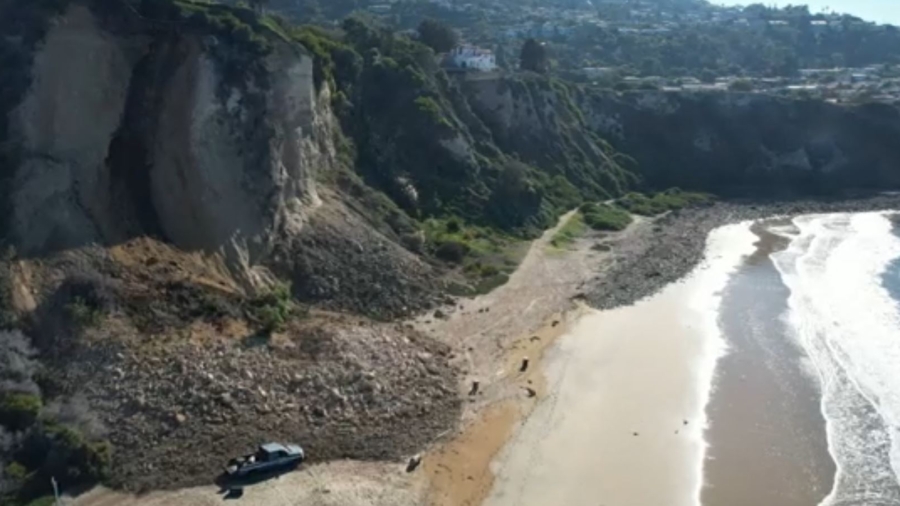
NASA released a study revealing that portions of a coastal city in Los Angeles County are sliding towards the Pacific Ocean as quickly as 4 inches per week, expanding the footprint of an ancient landslide complex that has troubled the area for decades.
"In effect, we're seeing that the footprint of land experiencing significant impacts has expanded, and the speed is more than enough to put human life and infrastructure at risk," said Alexander Handwerger, a JPL landslide scientist who conducted the analysis.
The City of Rancho Palos Verdes acknowledged the JPL's findings in a Feb. 6 statement, saying, "JPL's study confirms and validates what the City has been observing in its robust GPS survey monitoring of the landslide. The landslide has significantly accelerated and expanded since spring 2023 due to the unprecedented rainfall of the winters of 2023 and 2024."
The Palos Verdes Peninsula, located just south of Los Angeles, has been part of an ancient landslide complex for at least six decades.
However, the city also noted that the landslide has shown signs of deceleration since October 2024, attributing the changes to drier weather and the installation of deep dewatering wells. City officials said these wells have extracted more than 125 million gallons of water from the landslide area to date.
The situation has also affected iconic local landmarks. The Wayfarers Chapel, a popular wedding venue known for its glass walls, was permanently closed in 2024 due to land movement and is currently being deconstructed to preserve the structure.
Recent geological investigations have revealed that the landslide complex is more extensive than previously thought. City geologists discovered land movement deeper underground, which prompted a shift in strategies to slow its movement.
"We now realize it is this larger, deeper, slip plane that is moving, which is why our project that we've been working on since 2017 ... has to change," Rancho Palos Verdes City Manager Ara Mihranian said during an Aug. 20 city council meeting, as reported by The Epoch Times.
The deeper landslide, part of the Ancient Altamira Landslide Complex, sits about 245 to 345 feet below ground and has the potential to move upward of 50 feet per year, faster than the shallower landslides in the area.