


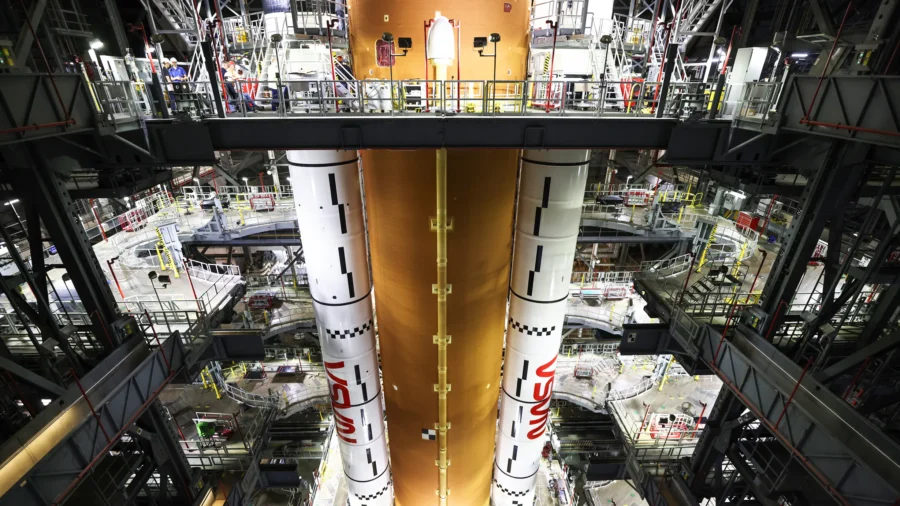
CAPE CANAVERAL, Fla.—For the first time in more than 50 years, NASA will roll out a human-certified moon rocket to the launchpad.
“It really doesn't get much better than this,” said John Honeycutt, who serves as Artemis II mission management chair. He added, “We’re making history.”
Honeycutt was joined by Artemis II managers, including Charlie Blackwell-Thompson, the mission’s launch director.
“We’ll be at a cruising speed of just under one mile per hour,” Blackwell-Thompson said, provoking laughter.
The 11-million-pound rocket is set to move along a four-mile route starting at 7 a.m. ET in an initial rollout before its much longer anticipated journey to the moon this year.
The event signals the start of what could be the final preparations necessary before it makes history. Called the Space Launch System, the orange, multi-stage rocket has been chosen by NASA as the backbone of its Artemis campaign to establish a sustainable presence on the moon.
Blackwell-Thompson outlined the several weeks of checks, tests, and configurations that need to happen before any go for launch can be given.
First, she said, it will take the rocket eight to 10 hours to complete the four-mile crawl from the Vehicle Assembly Building to Launch Complex 39-B. Once there, there will be several weeks of connecting, testing, and checking out various systems on the launch pad to ensure the rocket is completely flight-ready. At this time, ground crews will also configure emergency egress systems for the astronauts, who will participate in a walk down of the vehicle.
Those weeks will lead up to what NASA calls a “wet dress rehearsal” in early February. That is when the rocket is fully loaded with fuel and undergoes a true dress rehearsal of launch day, albeit without the crew present.
If everything performs as expected, Blackwell-Thompson will send the closeout crew to the pad to rehearse their procedures for securing the astronauts inside the Orion crew capsule, and her team will proceed with the countdown, stopping with only 29 seconds left on the clock.
She said that the wet dress rehearsal was the “driver” when it came to determining when Artemis II would be ready for launch. Some time would be needed to absorb and assess the data collected from it, and more than one wet dress rehearsal may be necessary, which could push back the launch even further.
The unmanned Artemis I mission launched in 2022 after enduring multiple wet dress rehearsals that uncovered several issues, such as hydrogen leaks. When asked how she and her team planned to avoid the long delays, Blackwell-Thompson affirmed that it would be due to the lessons learned from that first test flight.
“Artemis I was a test flight, and we learned a lot during that campaign and getting to launch,” she said. “And the things that we learned relative to how to go load this vehicle, how to load locks, how to load hydrogen, have all been rolled into the way in which we intend to load the Artemis two vehicle.”
For each coming month, Artemis II only has about a week-long launch window, or time frame for when the right parameters for the mission are met. For the next three months, those windows include Feb. 6, 7, 8, 10, and 11; March 6, 7, 8, 9, and 11; and April 1, 3, 4, 5, and 6.
While the original objective was to get the mission launched by the end of April, Blackwell-Thompson said that this week-long launch window is available every month this year.