

NATO Countries Still Tapping Russian Oil and Gas: What to Know

Trump criticized NATO allies at the United Nations for continuing to import Russian oil and gas despite pledges to phase out Moscow’s supply.
Published: 9/24/2025, 4:01:12 PM EDT
NATO Countries Still Tapping Russian Oil and Gas: What to Know
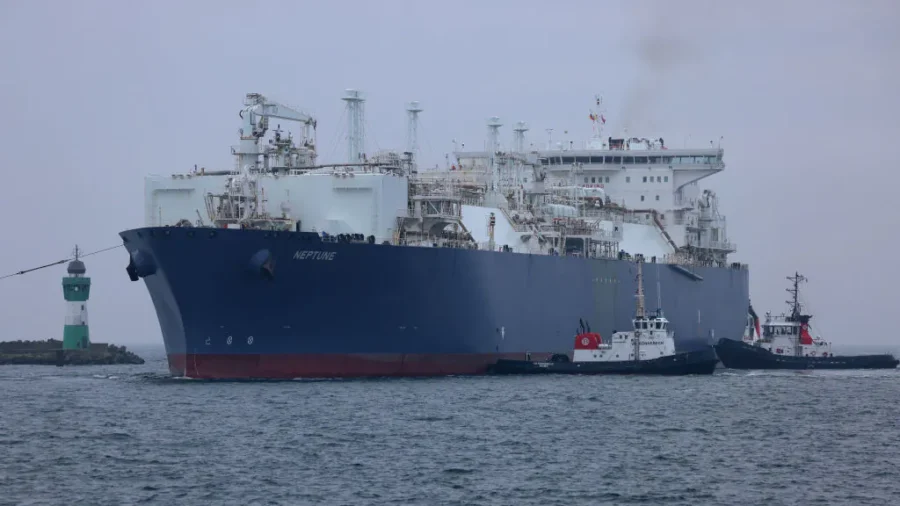
A ship carrying liquefied natural gas (LNG) arrives at Mukran Port in Sassnitz, Germany, on Nov. 23, 2022. (Sean Gallup/Getty Images)
During his speech at the United Nations, denouncing what he called its globalist agendas on immigration and green energy, President Donald Trump accused NATO countries of continuing to use Russian gas and oil and “funding a war against themselves.”

Since the start of the Ukraine–Russia war, the European Union, which is composed mostly of NATO members, has managed to cut its reliance on Moscow’s energy, but has yet to turn off the taps.

Here’s what to know about NATO countries’ ongoing use of Russian oil and gas, and why loopholes remain.

Europe’s Reliance on Russia

For decades, Europe’s energy system was built on Russian supply.

Before the Ukraine–Russia war in 2022, Moscow provided around 40 percent of the EU’s natural gas imports, along with significant volumes of crude oil and coal.

Pipelines such as Nord Stream 1 powered Germany’s industrial powerhouse, while countries such as Hungary, Slovakia, and the Czech Republic grew heavily reliant on Russian deliveries.

But after two years of war, Russian hydrocarbons continue to flow into NATO economies through both direct and indirect routes.

How Much Still Flows?

The EU has pledged to phase out Russian energy purchases entirely by 2028, though Washington has pushed for a faster timeline, in part to open space for U.S. exports.
Eurostat data show that Russia’s share of EU liquefied natural gas (LNG) imports stood at 12.9 percent in the second quarter of 2025, while pipeline gas accounted for 12 percent, with Norway, the United States, and Algeria displacing much of Moscow’s supply.
Following the EU’s seaborne crude ban in December 2022, the only remaining legal flows of Russian crude into the bloc come via the southern branch of the Druzhba pipeline, supplying Hungary, Slovakia, and the Czech Republic under exemptions.

The LNG Loophole

Currently, although the EU has largely banned Russian oil and coal imports, there are no EU-wide sanctions yet on buying Russian gas.

The European Commission, the EU’s main executive body, has urged member states to reduce imports to avoid what it sees as financing the Kremlin’s war chest.

This year, the EU adopted targeted measures that ban the transfer of Russian liquefied natural gas between ships in European ports for further delivery.

Which NATO Nations Still Use Russian Energy? 

Trump’s message was to NATO, not the EU, therefore including nations such as Turkey, a major buyer of Russian oil.
Last year, Turkey got 41 percent of its gas imports from Russia, Aura Sabadus, senior energy analyst at the ICIS consultancy, wrote on LinkedIn.
Belgium, France, and the Netherlands continue to buy Russian LNG, according to an April report from the Centre for Research on Energy and Clean Air (CREA).

On Sept 24, Hungarian Foreign Minister Peter Szijjarto—whose prime minister, Viktor Orban, is a key ally—said that the country will not stop buying Russian oil.

“We are a landlocked country,” Szijjarto told ATV television in an interview on Tuesday evening from New York, where he was also attending the U.N. General Assembly.
“It would be great if we had access to the sea; we could build an oil refinery or an LNG terminal on the coast and cover the entire world market. But that’s not the case.”

Trump’s Remarks

In his address to the U.N. General Assembly in New York City, Trump criticized NATO members for “funding the war against themselves” by continuing to buy Russian energy.

“But inexcusably, even NATO countries have not cut off much Russian energy and Russian energy products,” he said.

“Think of it, they’re funding the war against themselves.”

An Accelerated Timeline

The EU is keen to ramp up its Moscow energy decoupling. It had previously planned a phase-out by Jan. 1, 2028, but Trump has repeatedly urged the bloc to end Russian energy purchases faster before he does anything further to pressure Moscow.
Kaja Kallas, the EU’s foreign policy chief, said on Sept 19 on X that the new proposal aimed “to speed up the phase-out of Russian liquefied natural gas (to be complete) by 1 Jan 2027.”
On the same day, EU Commission President Ursula von der Leyen wrote that the bloc wants to end Russian fuel dependence “for good.”

“So we are banning imports of Russian LNG into European markets. It is time to turn off the tap. We are prepared for this,” she said.

“We are now going after those who fuel Russia’s war by purchasing oil in breach of the sanctions. We target refineries, oil traders, petrochemical companies in third countries, including China.”

Emel Akan and Reuters contributed to this report.