

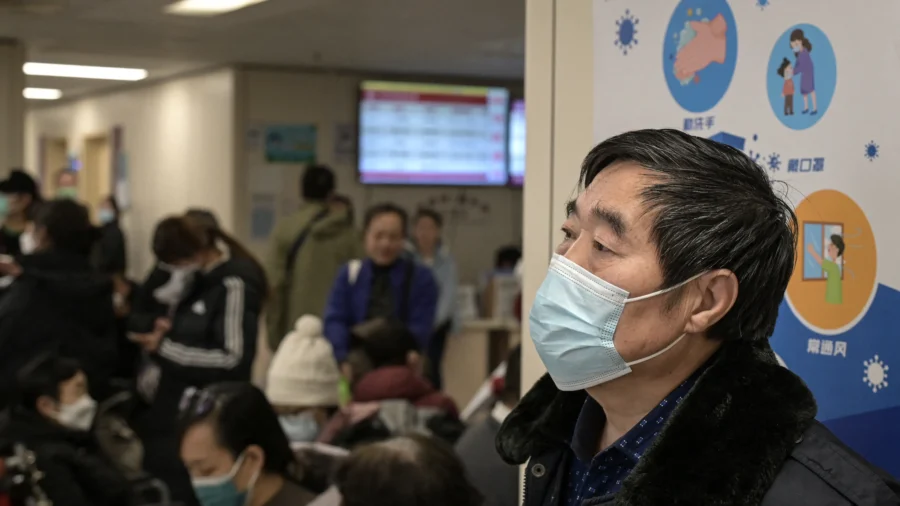
New Wave of COVID-19 Reported in China

A renewed surge of COVID-19 is spreading across China, with sentinel hospitals nationwide reporting a doubled positive detection rate over the past month.
Published: 5/16/2025, 11:42:06 PM EDT

A renewed surge of COVID-19 is spreading across China, with sentinel hospitals nationwide reporting that positive detection rates have doubled over the past month. Local citizens reported a spike in infections, including severe cases and fatalities.

Sentinel hospitals refer to hospitals designated for focused monitoring, control, and treatment of infectious or chronic diseases.

On May 16, the topic of "rising COVID-19 infections" trended on Chinese social media platforms, sparking discussions.

One netizen wrote: "My one-year-old baby got infected somehow and had a fever for two days and two nights. We thought it was influenza A or B, but when tested, it turned out to be COVID, and it quickly spread to us."

Another said: "There are really a lot of COVID [cases]. Before May Day, I went shopping, caught a cold, and had an unbearable sore throat. When I went to the hospital, it was COVID."

On May 8, the Chinese Center for Disease Control and Prevention (China CDC) released monitoring data for acute respiratory infectious diseases documented from March 31 to May 4, 2025.

The data revealed a rising trend in COVID-19 rates. Outpatient and emergency cases increased from 7.5 percent to 16.2 percent, while severe hospitalized respiratory infection cases rose from 3.3 percent to 6.3 percent.

Nationwide, respiratory samples tested positive for COVID-19 the most compared to other diseases, particularly samples from individuals over age 14, according to the China CDC.

Zhang Yue, a resident of Shandong province, shared his experience with The Epoch Times, saying: “A wave of COVID-19 hit in late March, nearly costing me my life. I was bedridden at home for half a month, mainly with respiratory and lung symptoms—nasal congestion, phlegm in the throat, recurring fevers.”
A young parent from Zibo city told The Epoch Times that their family contracted COVID-19 during the May Day holiday while traveling.

“Our whole family tested positive. The kids recovered quickly, in four, five days, but I was the slowest, taking 10 days. This time, the symptoms were noticeably milder than the first time I had it. I tried to tough it out for a few days but couldn’t, and I’m still coughing, probably with mild pneumonia,” the parent said.

Xu Ling from Beijing said she might have contracted the virus in a hospital emergency room. She said, “I’m almost recovered, but it has taken a long time. I took the COVID-specific drug cephalosporin.”
Another Beijing resident, Li Gang, said that his nearly one-year-old contracted COVID-19. “It was passed on by his grandmother, who was infected by a neighbor who had already tested positive.”

The Chinese regime has faced long-standing accusations of concealing epidemic data, particularly regarding death tolls.

In addressing the current resurgence, the China CDC has only released nucleic acid test results for respiratory samples, without providing detailed epidemic data.

Its website, which tracks the national COVID-19 situation, contains data only up to March 2025. Authorities reported 56,286 new confirmed cases in March, including 131 severe cases and seven deaths, which were attributed to underlying conditions combined with COVID-19 infection.

The epidemic was described as “fluctuating upward” but remaining at “a relatively low level.”

Zhang Yue said: “The COVID virus never ends; it never disappears. Hospitals don’t call it COVID, they just keep quiet about it. It’s tough—there’s no way to avoid infection, it’s just a matter of time.”
Xiao Qiang from Baoji city said rural doctors found the symptoms to be the same as the previous COVID pandemic, but they would rather call it a “cold.”
"There have been a lot of people with those colds recently,” Xiao Qiang said.

Cases Surge in Hong Kong, Singapore, Thailand

As COVID-19 cases are reported across Asia. Health authorities in Hong Kong and Singapore have raised alarms.
In Hong Kong, monitoring data from May 4 to May 10, 2025, shows key indicators for COVID-19 at their highest levels in over a year.

The proportion of respiratory samples testing positive has surged to 13.7 percent, up from 6.2 percent in early April, while sewage surveillance recorded elevated viral loads, indicating widespread community transmission.

Severe cases, including deaths, peaked at 31 in the week ending May 3, 2025, marking the highest level in nearly a year, according to the data.

Hong Kong authorities urge strict personal and environmental hygiene to prevent COVID-19 infection and community spread. High-risk individuals, including those with health conditions or weakened immunity, should take extra precautions, such as wearing masks correctly in public.

Singapore has also reported a 28 percent jump in cases, with an estimated 14,200 infections in the week through May 3, compared to 11,100 cases in the previous week, prompting the city-state’s first case update in nearly a year.

The Ministry of Health and the Communicable Diseases Agency are tracking a rise in COVID-19 cases in Singapore. Current variants show no evidence of increased transmissibility or severity compared to prior strains.

Thailand is also experiencing a resurgence of COVID-19 cases, particularly following the crowded Songkran festival in April. Between April 27 and May 3, hospitals reported 8,446 cases due to COVID-19, with Bangkok seeing the highest at 2,377 cases.

From May 4 to May 10, Thailand saw 16,607 infections and six deaths, double the previous week’s fatalities.

The surge has impacted public figures as well, with Hong Kong singer Eason Chan canceling concerts in Kaohsiung, Taiwan, after contracting COVID-19, according to an announcement from his music label.