

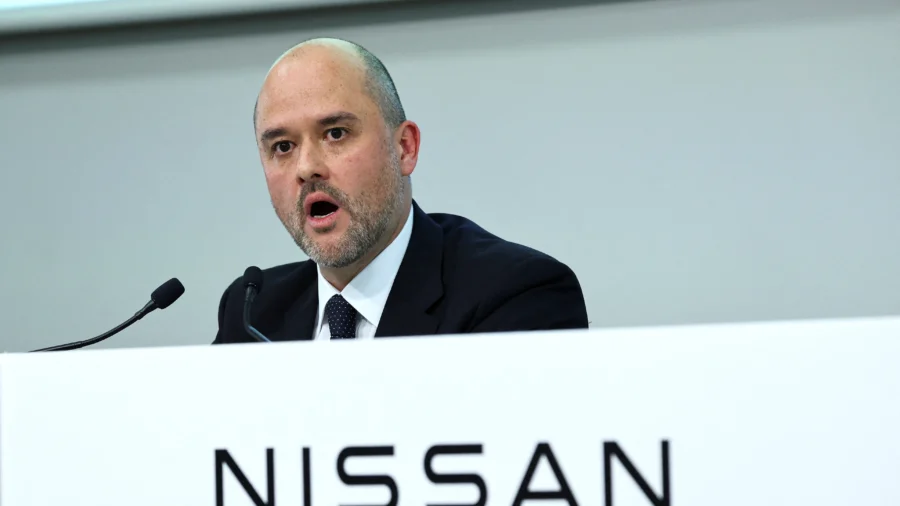
Nissan has restructured its leadership and is looking to dramatically reduce operating costs after a net loss of $4.5 billion (670.9 billion yen) in fiscal year 2024, which ended on March 31, 2025. Nissan’s woes are driven by challenges like Chinese EV competition, U.S. tariffs, inflation, and emission costs.
New CEO Ivan Espinosa and new CFO Jérémie Papin, have announced measures to reverse the decline.
Espinosa stated he would reduce operating costs by almost $3.5 billion, while facing a projected operating loss nearing $1.4 billion in what Papin described as another historically difficult first quarter.
Caught between factors including U.S. tariffs and Chinese EV makers, Espinosa took the helm in April of this year, shortly after the promise of a merger with Honda fell through in February. Espinosa cited Nissan’s high current cost structure, coupled with the extreme volatility of the present global market, as rationale for the need to achieve profits without relying as heavily on volume. Hence, he deemed slashing the labor force and facilities as necessary goals, slated for full implementation by 2027.
Variable costs will be reduced in part by ensuring a more efficient supply base to bring more volume with fewer and more efficient suppliers, he said. While some contracts may be lost, others will prevail.
Most visibly, total Nissan plants will be reduced by 40 percent, leaving 10 locations. Those remaining are to be given consolidated capabilities. Fixed costs will be reduced in part by combining vehicle and powertrain production facilities, accounting for the seven plant closures as well as most of the reduced workforce. The number of workers will be cut by an additional 8.8 percent, or 11,000 workers, on top of the 9,000 marked for dismissal in November of last year. This will leave Nissan’s remaining workforce standing at approximately 113,580 people.
Contractual staff will suffer most of the job cuts, with approximately 65 percent coming from manufacturing, 18 percent from sales, general and administrative staff, and 17 percent from R&D. Other cuts include reducing the complexity of parts by 70 percent and using a shortened development process for new vehicles, while factory output will be cut back to manage inventories. The shortened development process, to be trimmed by 30 percent, will impact the upcoming Nissan Skyline and the new versions of the INFINITI Compact SUV, and Global C SUV.
Espinosa said that in carrying out forward solutions, his team has “reassessed and scrutinized all the assumptions on which forecasts were based in the past.”
Notably, a slide from CEO Ivan Espinosa’s presentation on Nissan’s restructuring suggests that figures do not include the impact of the cuts to Nissan’s presence in China, including Dongfeng Motor Co., as a note on the relevant slide for the presentation indicates “Consolidated Plants (Excluding China).” For the prior fiscal year, China units decreased by 1,000.
Of the executives replaced in early 2025, top brass, including Uchida, held longtime affiliations with the Wuhan, China-based Dongfeng Motor Co., which is half-owned by Nissan. They have been replaced by executives with pedigrees more closely associated with Nissan holdings in the Western hemisphere. Dongfeng is a major player in the Chinese automotive industry.
Sales Pitfalls
Sales methodology will be revamped, going forward, according to Nissan CFO Jérémie Papin, who became CFO in January after the sudden executive restructuring that included replacing CFO Stephen Ma, formerly of Dongfeng Motor Co. Sales had languished due, in part, to an unrecognized U.S. market preference for EV hybrids as it came about, leaving Nissan with an inventory mismatched to the U.S. customer. This elicited a culture of reliance on sales movement based on costly incentives that artificially drove demand. Papin said incentives will continue, but with an eye toward improved inventory flow, pricing, and better-positioned offerings. Nissan anticipates upcoming new model launches will pique interest and drive sales.Pivot Strategies to Counter US Tariffs
Nissan’s efforts to mitigate the effects of U.S. tariffs include a focus on models assembled in the United States and U.S.-oriented partnerships for the region. This will be supported by maintaining a two-shift operation in Nissan’s Smyrna, Tennessee, plant for the Rogue, a compact crossover SUV, and growing collaboration with INFINITI and Mitsubishi, which will launch a battery electric vehicle based on Nissan’s LEAF in 2026.Redistributing China-Related Inventory and Production
Hints were made toward further exploration of localized production and markets. These shifts are key to recognizing that. In a climate in which US FCC Chair Brendan Carr has said Europe needs to choose between CCP-aligned tech and U.S.-aligned tech, Nissan is trying to hedge its bets while one hand definitely knows what the other one is doing. A presentation slide devoted to “Key Market Strategy” illustrated that, rather than distancing itself from China, Nissan’s strategy is to divvy its China offerings to regions that will take them, disseminating the technology to almost every other market that Nissan reaches other than the United States.Nissan anticipates that U.S. tariffs threaten to reduce 2025 earnings by $3.1 billion, an amount that Papin believes can be mitigated by 30 percent in the first quarter.
Papin approached the challenge of tariffs with an initial air of euphemism. “Operating profit is expected to break even for fiscal year 2025, excluding the potential impact from tariffs,” he said.
Ghosn said that now the stage is set for economic diplomacy to counter the trade imbalance, adding that for the United States, “I am sure that a lot of wins are going to be scored, particularly when there is a situation where there is a lot of unfairness and a total unbalance to this.”