


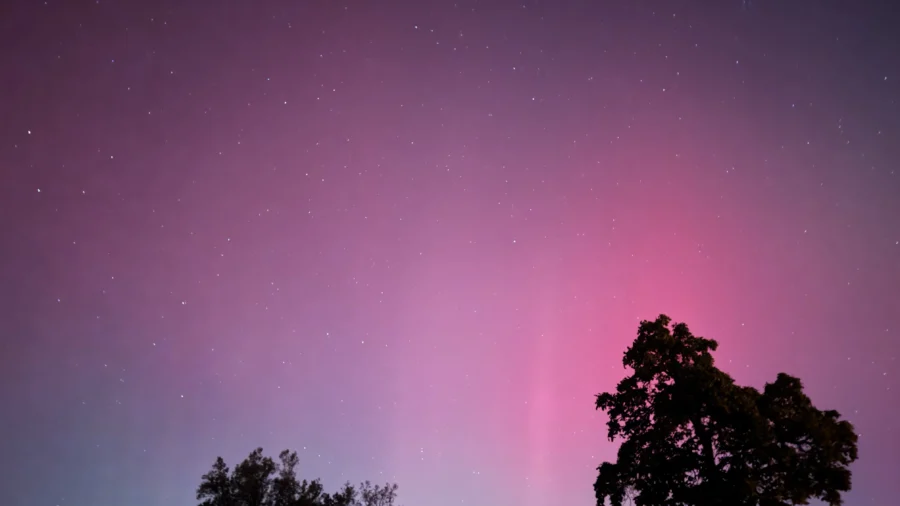
The northern skies of the United States could show extra flare this weekend, with the Northern Lights appearing in up to 15 states.
NOAA forecasts an aurora band of light that will cover Alaska and Canada but also reach into the northern mainland U.S. states, including Washington, Idaho, Montana, North Dakota, South Dakota, Minnesota, Wisconsin, Michigan, New York, Vermont, New Hampshire, and Maine.
Millions could view the aurora borealis on late Friday night and early Saturday morning. While the heart of the lights will run through Alaska and Canada, the geomagnetic storm activity can push the aurora further south, NOAA said.
Northern Lights are generally known for unpredictability, but the conditions suffice for viewing and photographing the aurora—even with a cell phone.
Auroras occur when sun particles, ions, converge with Earth’s ionosphere, which leads to the glow, according to the National Weather Service.
“The one of particular note is one just rotating in from the east … and that’s going to provide potential for possibilities of G1 minor storm levels,” Space Weather Prediction Center service coordinator Shawn Dahl said in a video. “If you’re interested in geomagnetic storm activity and potential for aurora viewing, that is something to watch as we go into the weekend.”
Based on NOAA’s geomagnetic storm scale, activity most likely will stay minor at G1. The K-index, the aurora’s distance from the poles, is four on a scale of zero to nine for Friday and three on Saturday. It’s recommended to view the Northern Lights between 10 p.m. and 2 a.m., per NOAA.
“These hours of active aurora expand towards evening and morning as the level of geomagnetic activity increases,” the NOAA said. “There may be aurora in the evening and morning, but it is usually not as active and therefore, not as visually appealing.”
Viewers will want to find a location with clear sky and away from light pollution. Aurora’s unpredictability requires waiting, and eyes need 20-30 minutes to adjust to the dark.
“For many people, the aurora is a beautiful nighttime phenomenon that is worth travelling to arctic regions just to observe,” the NOAA said. “It is the only way for most people to actually experience space weather.”