

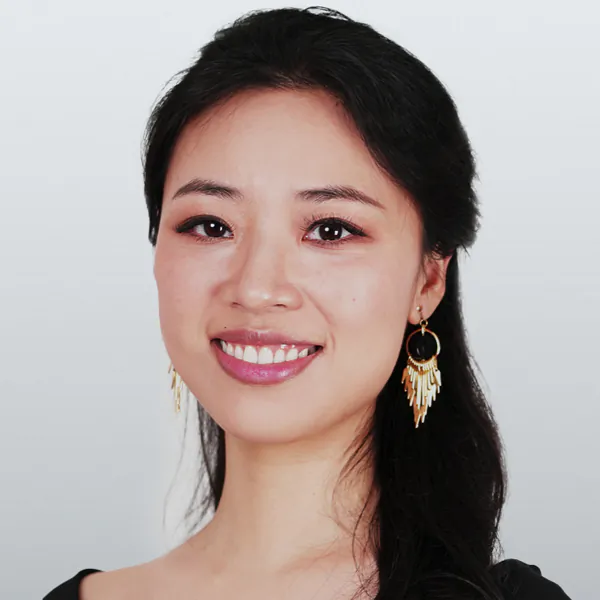
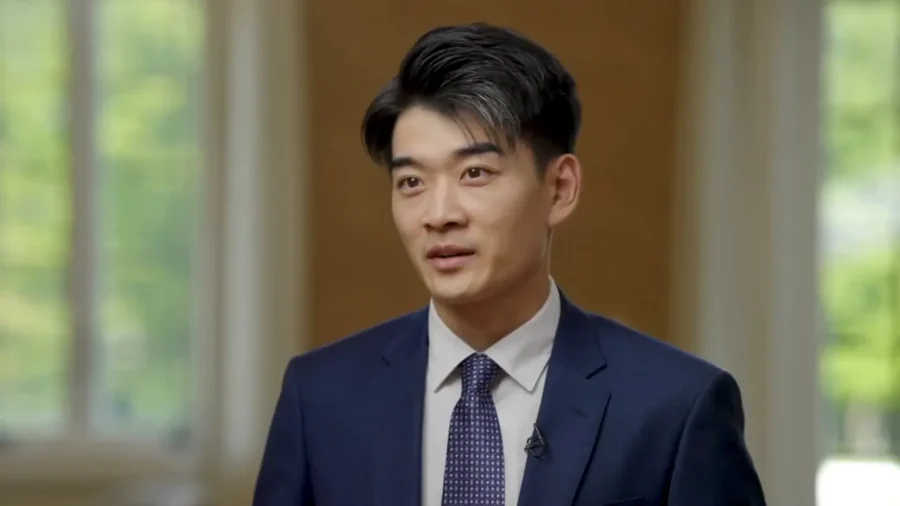
NTD’s International Classical Chinese Dance Competition is returning for its 11th year, bringing together top dancers from across the globe. NTD’s Sherry Ning sat down with one of this year’s judges for his insights on the art form and on this year’s contest.
Sherry Ning: With NTD's 11th International Classical Chinese Dance Competition just around the corner, today, I'm delighted to be joined by William Li. He's one of the judges this year. He's also a principal dancer with Shen Yun Performing Arts. William, welcome! Thank you so much for joining us here. Now, for our audience who may not be familiar, can you introduce classical Chinese dance to us a little?
William Li: Of course! Thank you for having me here! Classical Chinese dance is one of the most comprehensive dance systems in the world, and what makes it stick out is really ... it's very technical and very difficult, but the bearing aspect of it, the「身韻 (shen yun)」aspect of it, is really different from a lot of other dance forms, and we want to emphasize that inner spirit, the character and integrity of all of our dancers.
Sherry Ning: You mentioned a term called「身韻 (shen yun)」—I think you said it's "bearing." I also saw another term called "form"—I think it's called「身法 (shen fa)」. Could you introduce what those terms mean?
William Li: Form—「身法 (shen fa)」—is essentially the structure of classical Chinese dance. So it's going to be the movements, the movement in between every single pose, the different poses and postures, how your body moves. It's very technical. And「身韻 (shen yun)」is the "bearing." So this is where it gets really, really interesting. It's like the expression, the soul of a dancer. So every different movement that you have, for example, just a pose, let's say「按掌 (an zhang)」—this is just a movement. But when you add「身韻 (shen yun)」, when you do that movement, there's an inner bearing that you have, and that is really your communication with the audience. What are you trying to say with your dance movement? That is the「身韻 (shen yun)」aspect of classical Chinese dance.
Sherry Ning: How would you say classical Chinese dance is different from Western ballet or other forms of dance?
William Li: I think in ballet, it really emphasizes lines. It's also very, very technical, and there are a lot of similarities in that. And it's also very graceful. But in classical Chinese dance, it's, again, the bearing, and I think it's the cultural depth as well. It has 5,000 years of history, and it has really absorbed a lot of the essence of the different dynasties in Chinese history. So with such a rich and long history that's really reflected in the movements in classical Chinese dance, and you see it on stage, what the dancers are depicting is usually these historical themes, or these values that traditional Chinese culture emphasizes—these virtues, for example, like loyalty, filial piety, compassion. You're going to see a lot of these themes in classical Chinese dance.
Sherry Ning: Well, China has been, as we know, under communist rule for a long time. Now, a lot of traditional Chinese culture has been lost or suppressed in the meantime. Has this dance form suffered anything like that?
William Li: I think so, especially during the Cultural Revolution. That was when, under communist rule, traditional Chinese culture was being systematically destroyed. Literature, arts, and temples were getting smashed, and it has been systematically destroyed. It's not just here and there—it was all planned. And even the arts in China nowadays are often used as a tool for propaganda. So it doesn't matter if it's dance, if it's movies, if it's any kind of media that we consume, there's an agenda behind that media that is being depicted in China. But here in the West, and especially with Shen Yun Performing Arts, I think we're trying to show the world what true traditional China is all about, the real culture of the Chinese people. And one thing that I think really stands out is that Chinese history, a cornerstone of it was faith, like Buddhism, Taoism, and Confucianism. This is really a cornerstone of traditional Chinese history. And in China today, a lot of that is not depicted. But in our dance competition and in Shen Yun performances, a lot of that is depicted and shown to the world.
Sherry Ning: Now, bringing it back to our NTD competition this year—it's just days away. Can you tell us a little about what we can expect to see from the contestants?
William Li: Yes, so the contestants will prepare two pieces. One is a self-choreographed piece, and this usually depicts something from Chinese history. It could be a theme, it could be a character, or it could even be something from the modern day, but it usually depicts some of the virtues that Chinese culture emphasizes. And the other piece that you'll be seeing is a technical piece. So in a technical piece, there's a set of required movements that we'll be judging the dancers on. So some of the examples will be leaps, turns. There are tumbling movements, and that's what we're going to be seeing. And interestingly, a lot of these tumbling movements have inspired other art forms, such as gymnastics.
Sherry Ning: That's fantastic! Now, as a judge, what kind of qualities will you be looking for in those performances?
William Li: I think the most basic thing for me is「身法 (shen fa)」. That's the foundation of classical Chinese dance. Your movements, your poses, have to be precise. So it's like when you speak, or when you're giving a presentation, you have to speak clearly for your audience to understand. And then on top of that, I'm looking at your bearing, your「身韻 (shen yun)」, what are you trying to communicate to the audience? Can you really move the audience? As a judge, am I moved after watching your performance? I really want to see the dancers, when they're on stage, that they're sincere. So if you're depicting, maybe 岳飛 (Yue Fei)—he's a character who was known for his loyalty. You have to move me with your loyalty that's depicted on stage. Your movements have to look good. But on top of that, you have to be expressing something, whether it be compassion, whether it be courage, or loyalty, that has to come out through your movements. In Chinese, you say「內外合一 (nei wai he yi)」, so it's when your, almost your inner spirit and your physical movements become harmonious. That's what I think would be very, very touching for me as a judge, and as a dancer, when I watch that.
Sherry Ning: Wonderful! And we know that Shen Yun's Artistic Director, Mr. D.F., has also taught a technique. I think it's called「身帶手、胯帶腿 (shen dai shou, kua dai tui)」, which is "the body leads the hands" and "the hips lead the legs," right? So, can you tell us what that is? And is that something you will also be looking for in the contestants?
William Li: Yes, that's definitely something that we'll be looking for. And「身帶手、胯帶腿 (shen dai shou, kua dai tui)」is pretty much, I would say, the epitome of「身法 (shen fa)」skills. So it's a technique of how to move your body. And when you're using your body to express yourself, not just your limbs to do your movements, it becomes a lot more expressive. So you can imagine, when you're dancing, you could be really, really far from your audience—the audience could be 100 feet away, 60 feet away. They're quite far from you, and you're one person on stage. So the more expressive you are, and the bigger your dance movements are, the clearer your message to the audience will be. So it really makes your movements, whether it be your upper body or your lower body, your hips—it just makes your movement a lot more expressive. And, on top of that, it actually becomes easier for the dancers to move. It uses less force than just using your arms. It's kind of like using brute force to dance, but it flows a lot better.
Sherry Ning: Lastly, on a more personal note, I know this is the second time that you are judging in this competition. Have you also performed on stage as a contestant yourself?
William Li: Yes, I've competed quite a few times before! I think almost five times. So, quite a few times I've competed in the competition, so I know how the whole process is, and it's not easy to prepare these pieces and go and compete, putting yourself out there for the world to see. So I really respect a lot of these dancers, and it's great to see so many young people coming to preserve this tradition and culture and keep it alive, and also they're very, very talented and amazing dancers. So I'm really happy to see them competing.
Sherry Ning: And so our competition is just days away. It's going to be September 11 to 14, and the final two days will be livestreamed. Now, I'm sure all the contestants are busy in their last stages of preparation. Do you have any messages for them?
William Li: I think, for all of the contestants, you've already put in all of the work, and when you're on stage, just be sincere and enjoy yourself dancing. That's probably my best tip for you. And you'll be able to touch and move all of the judges, all of the audience members.
Sherry Ning: And for people who are not so familiar with our competition, do you have anything to say to our audience?
William Li: Yes, I think if you're not really familiar with classical Chinese dance, you should come with an open mind and come check it out, because it's really a living expression of 5,000 years of traditional culture. It's not like just reading a book or looking at some of the traditional paintings, but you're actually seeing these values and virtues of traditional Chinese culture live on stage. So it's definitely something worth seeing!