


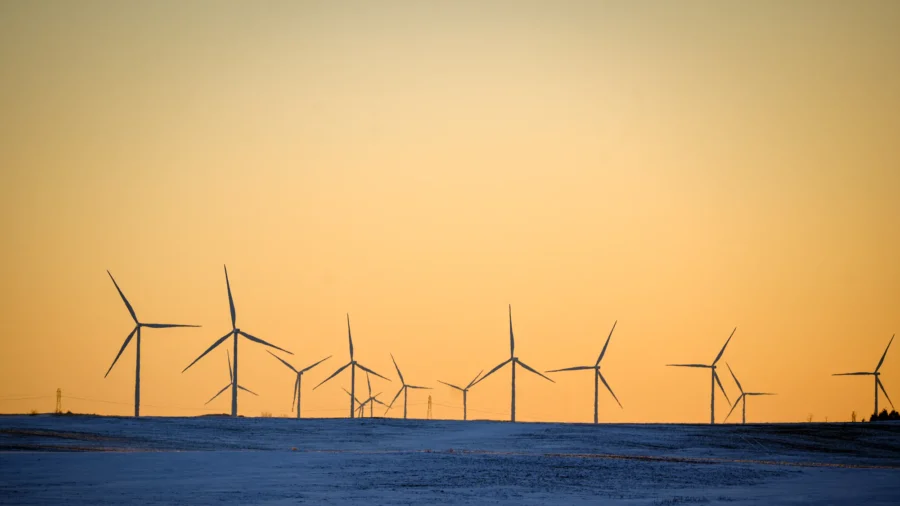
New York and six other state attorneys general are suing the Trump administration over a deal it cut with a French wind farm developer that canceled an offshore lease and stalled New York’s offshore wind power plans.
New York State Attorney General Letitia James is leading the lawsuit, which argues that the deal was illegal because the Department of the Interior's authority to cancel such leases requires a hearing to determine if canceling the lease would be better than allowing it to go ahead. The lawsuit argues the government held no such hearing weighing the harm of canceling the lease versus allowing the wind turbine farm to continue.
The lease covers 84,000 acres of a shallow region between Long Island, New York, and the New Jersey coast. New York state and New Jersey both had agreements with Attentive Energy to build wind turbine farms that would provide energy for up to hundreds of thousands of homes.
In March, the Department of the Interior, which manages offshore leases, announced it reached a deal with Attentive Energy’s parent company, TotalEnergies USA. In the deal, TotalEnergies is to be reimbursed for the $795 million it paid for the offshore lease in exchange for dropping the project. TotalEnergies also agreed to reinvest $1 billion in oil and natural gas production in the United States.
That suspension was later overturned in early 2026 when federal district courts reviewed the administration’s classified national security risk assessment and disagreed that the projects posed imminent risk to national security.
The Department of the Interior announced the deal with TotalEnergies on March 23. In the deal, TotalEnergies also agreed not to pursue any future offshore wind power projects in the United States. In the announcement, Secretary of the Interior Doug Burgum called offshore wind power “the most expensive, unreliable, environmentally disruptive, and subsidy-dependent” energy source among available options.
The lawsuit from New York Attorney General Letitia James is the latest twist in a legal battle over offshore wind power production that traces back to the first day of Trump’s second term, when he issued an executive order halting permitting and leasing for new offshore wind power plants. The Trump administration has argued that wind and solar pose national security risks as they rely on supply chains dominated by Chinese manufacturers.
Six states—Connecticut, Maine, Massachusetts, New Jersey, Rhode Island, and Vermont—joined New York in filing the lawsuit.
Environmental group Oceantic Network welcomed the action, arguing that the cancellation of these projects can cause loss of economic output in the billions of dollars.
“For more than a year, offshore wind has faced an unprecedented and unrelenting campaign of political interference despite billions in private investment, state commitments, and court rulings,” Liz Burdock, president of Oceantic Network, said in a statement.
Battle Delays New York’s Climate Plan
The battle with the federal government over wind power has thrown a wrench in New York State’s climate targets. Under a climate law passed in 2019, New York set aggressive goals to reduce carbon emissions to 40 percent of 1990 levels by the year 2030.Setbacks in developing offshore wind power and other new non-carbon-emitting power sources in New York have weakened the reliability of the state’s power grid. According to New York’s grid authority, older plants have been shutting down even as cleaner replacement energy sources are not yet up and running.