



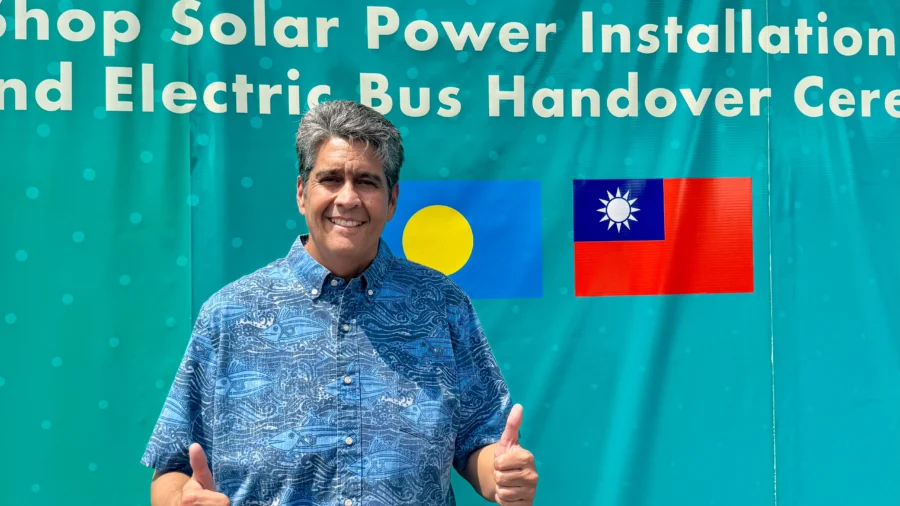
KOROR, Palau—Taiwan’s participation in a regional summit in the Pacific has highlighted Palau’s determination to pursue its own diplomatic choices despite growing pressure from Beijing.
Palau is hosting this year’s Pacific Islands Forum (PIF) Leaders Meeting, bringing together leaders of the region’s foremost 18-member bloc, including Australia and New Zealand. It has invited Taiwan to participate in events associated with the gathering after last year’s host, the Solomon Islands, excluded Taipei and other development partners, despite Taiwan’s participation in the forum since 1993.
Palauan President Surangel Whipps Jr. said there was no reason that Taiwan shouldn’t participate in the forum.
“Taiwan is a partner; they’re a development partner. They contribute to PIF funding. They contribute to the Pacific Resilience Facility so they are part of PIF. And last year, we reaffirmed that in the communiqué,” Whipps told The Epoch Times on Aug. 30.
In July, Taiwan donated $2 million to the forum to help it implement the group’s 2050 Strategy for the Blue Pacific Continent.
Palau’s diplomatic choice has drawn economic pressure from Beijing, and Whipps criticized China for “weaponizing” tourism by throttling the flow of Chinese visitors to the Pacific island nation. On Aug. 11, China’s foreign ministry voiced opposition to Taiwan’s participation in this year’s forum. Eight days later, China’s Ministry of Culture and Tourism issued a travel warning for Palau, one of the region’s safest countries, urging its citizens to exercise caution, citing reports of theft and robbery targeting tourists.
The United States, meanwhile, has rejected China’s warning as an attempt to pressure Palau through tourism.
“The United States opposes any attempts by China to weaponize tourism to coerce Palau,” the U.S. Embassy in Koror, Palau’s largest city, said in a statement on Aug. 29.
It called on Beijing to “cease all its coercive activities against Palau,” while noting that the U.S. State Department continues to rate Palau at Level 1, describing it as a “generally safe destination for U.S. travelers.”
Cleo Paskal, senior fellow at the Palau-based think tank Compass Point Institute, noted that China’s travel warning was issued not only by the Chinese foreign ministry but also by its embassy in the region.
“It’s worth noting that the Chinese press release says it is also from the ‘Chinese Embassy in the Federated States of Micronesia,’” Paskal told The Epoch Times on Aug. 30. “China is using a base in a neighboring Pacific Island country to attack Palau. This is consistent with repeated Chinese attempts to divide the region and use its proxies to attack their cousins.”
The United States, a dialogue partner of the forum, is returning to this year’s gathering after being blocked from attending last year’s meeting. Deputy Secretary of State Christopher Landau will participate in the forum’s leaders’ meeting in Palau as part of a regional trip that also includes stops in the Federated States of Micronesia, Solomon Islands, and Kiribati.
Founded in 1971, the forum gives the 18 member nations a collective voice on issues such as climate change, resources and economic development, security, and ocean and environment. Together, their combined exclusive economic zones cover nearly 20 percent of the world’s surface.
China has repeatedly used its control over outbound tourism as a tool of economic and political pressure, with Taiwan, South Korea, and Japan being notable targets.
The United States maintains Compacts of Free Association with the Marshall Islands, Federated States of Micronesia, and Palau. These are bilateral agreements that build whole-of-society ties, including economic aid, healthcare, defense, education, aviation, and more, in exchange for U.S. strategic access to the Pacific.
Renewed agreements were signed in 2023 but funding was not finalized until Congress approved legislation in March 2024, unlocking $6 billion collectively in assistance through 2043. These agreements are a key part of U.S. efforts to sustain a free and open Indo-Pacific.