



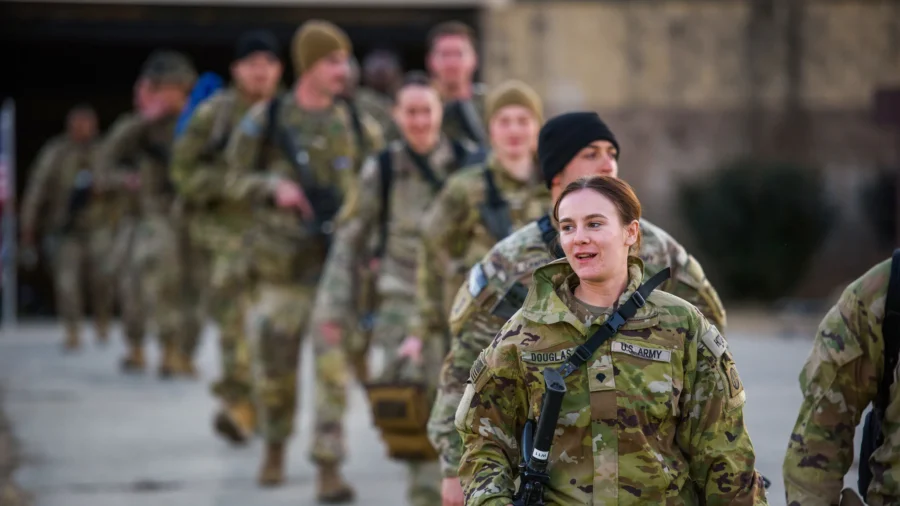
The Pentagon will deploy elements of the elite Army 82nd Airborne Division to the Middle East.
A source at the Pentagon familiar with the plans confirmed that the division would be deployed, though they didn't provide other details on the plans.
The 82nd Airborne is one of the most renowned forces in the U.S. military. Members of the 82nd Airborne were among the U.S. forces deployed to France ahead of the D-Day invasion of Normandy; since then, they've been involved in the Gulf War in the 1990s, conflicts related to the War on Terror, and a series of more recent deployments to the Middle East in the wake of the U.S. withdrawal from Afghanistan.
A key element of the 82nd Airborne is the Immediate Response Force, a force composed of around 3,000 to 4,000 soldiers. These highly-trained special forces are able to parachute into hostile territory and secure key infrastructure, airfields, and other land targets.
The force is required to be able to deploy anywhere in the world within less than a day.
Further details on the Pentagon's plans for the 82nd Airborne or the Immediate Response Force remain unclear.
The deployment comes as the U.S. military has carried out airstrikes on Kharg Island. The eight-square-mile island, 16 miles from Iran’s Persian Gulf coast, is the source of 90 percent of the country's oil exports.
On March 13, Trump wrote about the strikes in a post on Truth Social.
“The United States Central Command executed one of the most powerful bombing raids in the History of the Middle East, and totally obliterated every MILITARY target in Iran’s crown jewel, Kharg Island,” Trump wrote.
He warned that the decision not to target oil facilities could be reversed.
“I have chosen NOT to wipe out the Oil Infrastructure on the Island. However, should Iran, or anyone else, do anything to interfere with the Free and Safe Passage of Ships through the Strait of Hormuz, I will immediately reconsider this decision.”
Speaking about the broader state of Iran on Tuesday, Trump said that the Iranian regime has agreed not to pursue nuclear weapons in order to stop the U.S. military from striking the country.
“There won’t be any nuclear weapons,” Trump said at the White House, adding that Iran “has agreed to that.”
Trump said that “we’re in a good bargaining position” and said Iran is mostly “defenseless.”
Since the U.S.–Israel air strikes, the Strait of Hormuz, which connects oil-rich nations around the Persian Gulf to the broader ocean, has effectively been shut down by Iran.
That comes as Israel said on Tuesday that it carried out an extensive series of strikes targeting Iran's “production sites.” In Tehran, a massive blast was heard in northern neighborhoods and another in the city center.