


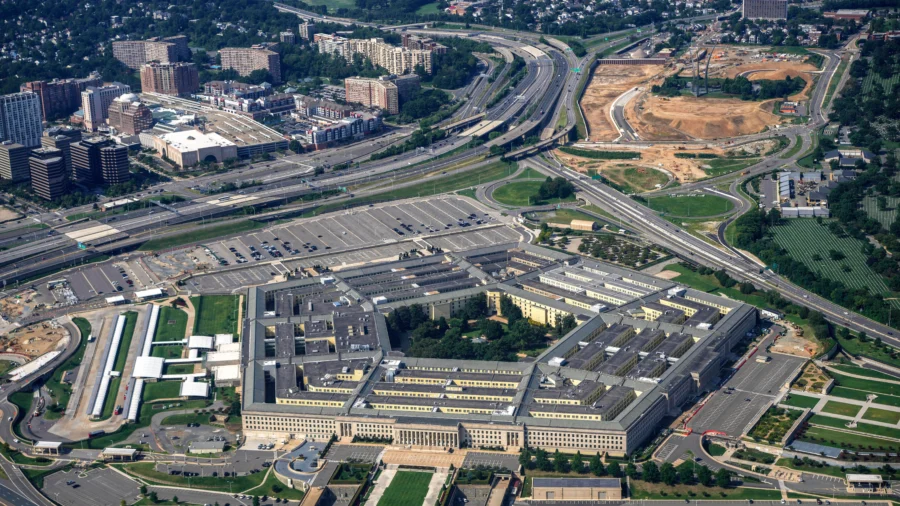
The Pentagon unveiled its latest National Defense Strategy on Jan. 23, which places the homeland defense and protection of U.S. interests in the Western Hemisphere as the top priority over countering China.
“We will engage in good faith with our neighbors, from Canada to our partners in Central and South America, but we will ensure that they respect and do their part to defend our shared interests,” the document said. “And where they do not, we will stand ready to take focused, decisive action that concretely advances U.S. interests.”
Deterring China in the Indo-Pacific region comes second in the strategy, with the Pentagon emphasizing that its goal is to prevent the Chinese Communist Party from dominating the United States and its allies.
The Pentagon said its strategy will center on promoting strategic stability and pursuing “deconfliction and de-escalation more broadly” in the Indo-Pacific, but also remain clear-eyed about the speed and scale of China’s “historic military buildup.”
“Our goal in doing so is not to dominate China; nor is it to strangle or humiliate them,” the document said, noting that President Donald Trump seeks to have “a stable peace, fair trade, and respectful relations” with the Chinese regime.
The strategy also calls for increased burden-sharing from U.S. allies and partners, criticizing their long-standing reliance on previous U.S. administrations to subsidize their defense.
The Pentagon said it expects allies to take “primary responsibility” for their own defense in Europe, the Middle East, and the Korean Peninsula, with U.S. forces providing only critical but limited support, so that the United States could refocus on homeland defense and the Indo-Pacific.
“Ours is not a strategy of isolation,” the document said. “In all cases, we will be honest but clear about the urgent need for them to do their part and that it is in their own interests to do so without delay.”
On North Korea, the Pentagon assessed that South Korea has the will to take primary responsibility for deterring Pyongyang’s military threats, with “critical but more limited” U.S. support, noting that this shift aligns with America’s interest to update U.S. force posture in the region.
The Pentagon said Russia “will remain a persistent but manageable threat to NATO’s eastern members,” but it assessed that NATO allies are much more powerful and “strongly positioned” to take primary responsibility for Europe’s conventional defense.
“At the same time, although Europe remains important, it has a smaller and decreasing share of global economic power. It follows that, although we are and will remain engaged in Europe, we must—and will—prioritize defending the U.S. homeland and deterring China,” it said.
The strategy also includes a focus on supercharging the U.S. defense industrial base, which it said is necessary to ensure the industrial base can effectively meet current and future challenges.
The industrial base “undergirds the other key pillars of this strategy,” as it ensures U.S. forces have the weapons and capabilities needed to meet priorities and sustain U.S. support for allies, according to the department.
The Pentagon said it will reinvest in U.S. defense production by building out capacity, supporting innovation, adopting emerging technology, and removing outdated policies and regulations that constrain production.
“We must return to being the world’s premier arsenal, one that can produce not only for ourselves but also for our allies and partners at scale, rapidly, and at the highest level of quality,” the document said.