


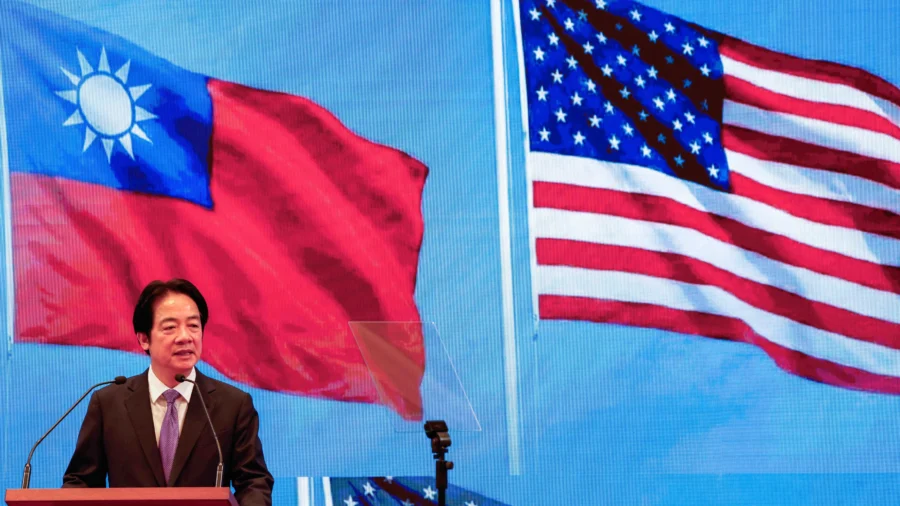
Taiwanese President Lai Ching‑te said on May 17 that peace and stability of the Taiwan Strait “will never be sacrificed or traded,” and that U.S. arms sales to Taiwan rest on a security commitment grounded in the Taiwan Relations Act, issuing his first comments since U.S. President Donald Trump’s summit with Chinese leader Xi Jinping in Beijing that ended May 15.
In a statement shared on social media, Lai thanked Trump and U.S. Secretary of State Marco Rubio for reaffirming longstanding U.S. policy toward Taiwan, while stressing that peace in the region depends on strength, the resolve to "protect freedom and democracy," and cooperation with friendly countries.
Trump Calls Arms Package a Negotiating Chip
Lai’s statement followed comments made by Trump in a Fox News interview recorded in Beijing and aired Friday evening, May 15.When asked whether people in Taiwan should feel more or less secure after meeting with Xi, Trump said, “Neutral. This has been going on for years.”
He added, “I’m not looking to have somebody go independent ... I want them to cool down—I want China to cool down.”
Trump said that during the summit, Xi asked him directly whether the United States would defend Taiwan if China attacked.
“There’s only one person that knows that,” Trump said. “I said, ‘I don’t talk about that.’”
On the pending $14 billion U.S. arms package for Taiwan—pre‑approved by Congress in January 2025 but not yet formally advanced—Trump told Bret Baier, “I may do it. I may not do it. I’m holding that in abeyance, and it depends on China, it depends. It’s a very good negotiating chip for us, frankly. It’s a lot of weapons.”
A bipartisan group of senators urged Trump on May 11 to formally notify Congress of the pending $14 billion package before the Beijing summit, saying U.S. support for Taiwan “is not up for negotiation.”
Lai's Message
Lai in his statement outlined five key points addressing concerns among Taiwanese after the island was raised during the Trump–Xi meeting.Firstly, he reiterated that Taiwan, as the defender of the cross‑strait status quo, has no intention to provoke or escalate conflict but will not be pressured by the Chinese Communist Party into giving up its "national sovereignty and dignity, and democratic and free way of life."
Secondly, Lai noted that China’s military activity—including air and naval operations, large‑scale exercises, and gray‑zone coercion—has expanded in recent years. He said these actions by China are what present a threat to "regional peace and stability" for the first island chain and the broader Indo‑Pacific—not actions from Taiwan.
He then rebuffed China, saying that “there is no ‘Taiwan independence’ issue,” as the Republic of China (ROC) is a sovereign and independent democratic country that adheres to a liberal and democratic constitutional system. He said Taiwan’s sovereignty "cannot be invaded and annexed," and that Taiwan is willing to pursue “healthy and orderly exchanges” with China on the basis of parity and dignity, but rejects coerced exchanges or United Front activity.
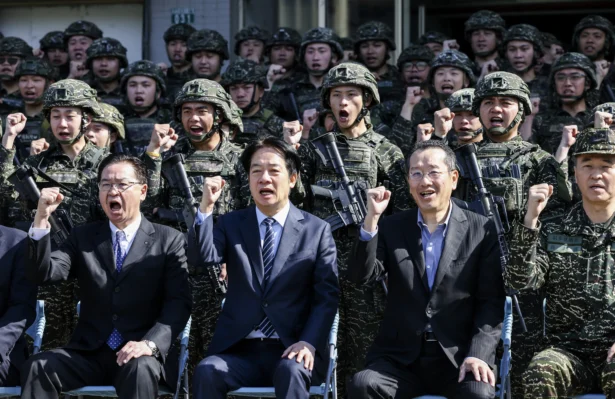
Fourth, Lai said that long-term Taiwan–U.S. security cooperation is built on the Taiwan Relations Act, which has been and remains "the U.S. security commitment to Taiwan." He said the arms sales that come from that are key elements for maintaining regional peace and stability, and thanked Trump for his support of Taiwan during both terms.
Finally, Lai said that "peace and stability in the Taiwan Strait will never be sacrificed or traded" as disruptions would "affect global supply chains and the world economy." He also argued that "Taiwan will absolutely not be sacrificed or traded" as a "critical node of Indo-Pacific security, the core of global AI and semiconductors development, and an indispensable part of global supply chain re-engineering."
Trump told reporters after the summit that he would have to speak with Lai about the pending arms sale.
"I have to speak to the person ... that's running Taiwan," he said.
A senior Taiwan security official told Reuters, speaking on condition of anonymity, that Trump’s remarks imply the arms sale is a matter between Washington and Taipei.
Taiwan Relations Act and the Six Assurances
The Taiwan Relations Act, enacted in 1979, establishes that it is U.S. policy to provide Taiwan with arms of a defensive character and to maintain the capacity to resist force or coercion that would jeopardize Taiwan’s security or social and economic system. The law forms the legal security framework for U.S. policy toward Taiwan, while leaving the nature and timing of specific arms sales to presidential and congressional decision‑making.The 1982 Six Assurances—U.S. commitments to Taipei that include not consulting Beijing on arms sales—remain policy rather than statute. Legislation to codify them, the Six Assurances to Taiwan Act (H.R. 3452/S. 3208), remains pending in Congress.
According to China's Ministry of Foreign Affairs, Xi told Trump that for Beijing, the Taiwan question is the most important issue in U.S.–China relations.
What Lies Ahead
After the summit, Chinese Foreign Minister Wang Yi said that Xi accepted Trump’s invitation to visit the United States in the fall on Sept. 24, setting up a third meeting in Trump's second term ahead of the midterm elections on Nov. 3 and the Nov. 9 port‑fee suspension deadline.Meanwhile, Taiwanese Foreign Minister Lin Chia‑lung said Taiwan would continue strengthening its self‑defense capabilities and working with pro-democracy partners.
“Peace depends on strength,” Lai's statement read, saying that Taiwan would maintain the status quo “neither submissively nor arrogantly” while working to "make positive contributions to regional and global peace and prosperity."