


This week, the world’s attention was focused largely on the landmark summit between President Donald Trump and his Russian counterpart, Vladimir Putin, in Alaska.
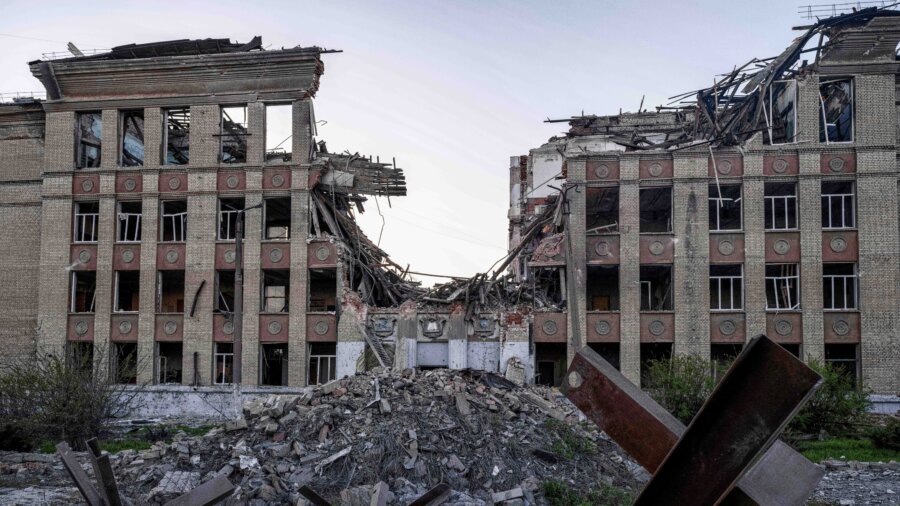
But preparations for the event have coincided with significant military developments in Donetsk, where Russian forces this week staged a sudden thrust several miles into Ukrainian-held territory.
While Ukrainian officials say the situation has stabilized, the Russian advance has prompted fears of a potential collapse of Kyiv’s defense lines.
“The front hasn’t collapsed, but the risk is high,” Abdullah Agar, a prominent Turkish military analyst and former Special Forces officer, told The Epoch Times.
“A breakthrough has been prevented for now, but the [Ukrainian] lines are under extreme strain,” he said.
British defense analyst Tim Ripley said it was “too soon to say” whether Ukraine’s defense line was buckling under the pressure.
But recent developments suggest a “growing trend of increasing porousness along the [Ukrainian] frontline,” he told The Epoch Times.
“The Russians aren’t using mass tank or vehicle attacks,” Ripley said. “They’re sending small groups of soldiers to dodge past Ukrainian positions.
“The Ukrainians, fearing they’ll be trapped in their trenches, just withdraw—they are unhinging defensive positions.”
Of enormous strategic importance, Pokrovsk is a vital Ukrainian transit hub, the capture of which has long been a key Russian objective.
“Losing Pokrovsk would make defending key cities like Sloviansk and Kramatorsk much harder,” Agar said.
“If Russia cuts the supply route from Dobropillia to Kramatorsk, Ukraine’s defense would face severe problems in terms of morale, resources, reinforcements, and evacuations, creating serious operational setbacks.”
According to Ripley, there are “four encirclement operations underway along the Donetsk-Luhansk frontline; four bulges the Russians are trying to squeeze.”
Raising Alarm Bells
On Aug. 11, DeepState, a Ukrainian blog that tracks military developments, said that Russian forces, “through constant pressure and with superior troop numbers,” had advanced on two settlements near Dobropillia.The frontline situation, it said, “is developing quite chaotically, because the enemy, having found gaps in defenses, is infiltrating deep into the area.”
Ukraine’s military has played down the scale of the Russian advance while sending additional troops to the Donetsk frontline, including units from its Azov Battalion.
“The situation in the Dobropillia sector has stabilized,” he wrote on Telegram. “Thanks to the heroic efforts of our Defense Forces, the frontline is … holding.”
“The most interesting combat indicator is the evacuation order,” Ripley said. “The fact that they’re ordering civilians to evacuate suggests they are worried.”
In a social media post addressed to Zelenskyy, Krotevych said the Pokrovsk-Konstantynivka defense line was in “total chaos” and was “getting worse every day.”
“A stable line of combat contact effectively doesn’t exist,” he wrote on social media platform X on Aug. 11.
“Pokrovsk and [the nearby town of] Myrnohrad are almost surrounded,” he said. “Kostyantynivka is semi-encircled. The enemy is advancing towards Kramatorsk and Druzhkivka.”
According to Agar, Krotevych’s claims “perfectly sum up the uncertainty on the front and the stop-gap measures, shifting positions, and flexible defense that have become necessary.”
“With the precautions Ukraine has taken, the reinforcements it has sent, and the forces it has committed, the fight at this critical pressure point has taken on a new form—what I call ‘flexible defense’,” he said.
“Kostyantynivka can fall without a fight if they [the Russians] manage to do it. They will simply cut off logistics,” he said. “Further north from the Lyman side, they are trying to cut off Sloviansk in the same way.”
Agar said that Ukraine—and its allies—were “fully aware” of what a Russian breakthrough would mean for the wider frontline.
“That’s why they will almost certainly try to develop new measures,” he said. “If they don’t, or can’t, the military and political environment—and overall strategic posture—will have to adjust to this [frontline] rupture.”
‘Fluid Conflict’
Ripley described the situation in and around Pokrovsk as “very precarious.”“The first breakthrough occurred to the south, and they [Russian forces] now appear to be inside the city,” he said. “And you now have a breakthrough northeast of the city, which is going directly north.”
“The one going north, which took place on Monday, has cut two main roads, prompting the evacuation orders,” he added. “That puts the Russians in a position to strike at Sloviansk and Kramatorsk—the last two holdouts in Donetsk.”
Agar believes that, ultimately, “the outcome will hinge on the ability of Ukraine and its allies to restore a balance on the frontline and Russia’s ability to exploit its successes.”
“This is a fluid conflict shaped not only by what happens on the ground, but by larger outside forces,” he said. “NATO support, a potential Russian misstep, the results of negotiations … or even an effective threat from Trump could all become decisive factors.”
“The West’s goal is to pressure Russia—through war and sanctions—to the point where they can reshape it into something they want,” Agar said. “Some believe they’re very close to getting there.”
“Ukraine faces serious risks, but so does Russia. This is, at its core, a war of endurance.”