


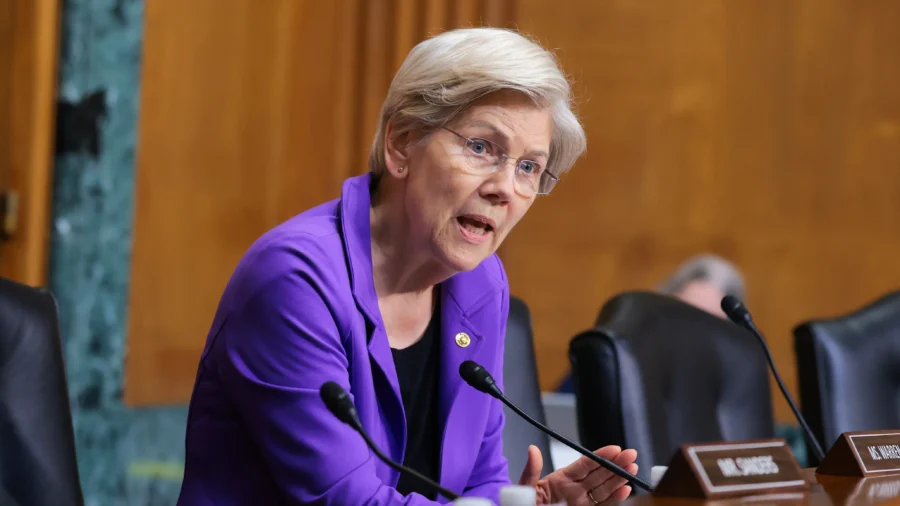
Sen. Elizabeth Warren (D-Mass.) has introduced a new legislation aimed at strengthening ethics rules and increasing transparency for special government employees, or SGEs—a category that includes Elon Musk.
It targets concerns raised by Congress over SGEs—temporary federal employees who are allowed to continue their employment outside of government, which Warren said could lead to conflicts of interest.
Warren questioned why existing ethics rules do not appear to fully cover Musk’s role in the Trump administration, and pointed to what she described as gaps in oversight.
The bill states that SGEs can present significant financial conflicts of interest due to their private-sector ties. While SGEs are subject to criminal conflict-of-interest laws, current regulations do not always require them to resolve such conflicts if their government duties do not constitute a “particular matter.”
A key provision of the SEER Act would extend existing ethics requirements to apply more fully to SGEs. Under current law, some ethics rules apply only partially to SGEs, or not at all.
The legislation proposes that core ethics rules take effect on an SGE’s 61st day of service, with restrictions on outside compensation beginning on day 131. By law, Musk—as a designated special government employee—is permitted to formally serve in a government role for no more than 130 days.
The bill also seeks to establish a clear standard barring SGEs from communicating in an official capacity with federal agencies that oversee or have contracts with companies they lead or own, particularly if those companies are worth over $1 billion, hold large federal contracts, or dominate an industry.
“That way, when the government awards SpaceX with a $6 billion contract … Musk won't be able to talk with the Space Force or any other agency that holds contracts with his company,” Warren said.
The legislation would further require SGEs to resolve conflicts of interest if their federal work would directly and predictably impact their non-government employers, even when those projects have broader public implications.
Under the bill, the Office of Government Ethics would be required to concur before any conflict-of-interest waiver is granted to an SGE.
The SEER Act would mandate that financial disclosures and conflict-of-interest waivers for SGEs be made publicly accessible without formal requests. It would also require SGEs to be officially listed in the Office of Personnel Management database, which would be expanded to include a publicly searchable, electronic record.
She also pointed to past examples from the Trump administration as evidence of how she claimed the classification could be used to evade oversight.
“You just can't get anything done," Musk said.
When Elon Musk was appointed as an SGE by President Donald Trump, his dual role as a federal adviser and the CEO of companies with major government contracts led democratic lawmakers to raise their concerns about potential conflicts of interest. For example, Musk’s Department of Government Efficiency (DOGE) recommended staff reductions at the National Labor Relations Board, which had filed complaints against SpaceX.
Similarly, the Equal Employment Opportunity Commission and the Office of Federal Contract Compliance Programs—both investigating alleged discriminatory practices at Tesla and SpaceX—faced budget cuts and operational changes under initiatives associated with DOGE.
Additionally, Musk's advisory role on space policy, his criticism of NASA's missions, and his advocacy for initiatives aligning with SpaceX's interests, combined with SpaceX's dominance in U.S. rocket launches, has heightened concerns regarding fair competition in government contracting.
However, the White House has addressed criticism surrounding Musk, stating that he is complying with all federal laws.
“Elon Musk is, I’ve confirmed before, is a special government employee. He is filing the proper financial disclosure. And he is complying with all applicable federal laws,” White House press secretary Karoline Leavitt said in February, responding to a question about potential conflicts of interest involving Musk.
She added that “before [Musk] moves forward with anything, he consults with the president of the United States.”
“We’re very confident with the ethics and the guardrails that have been put in place here,” Leavitt said.
Addressing concerns about Musk's potential conflicts of interest, Trump said in February that, “We would not let him do that segment or look in that area if we thought there was a lack of transparency or a conflict of interest.” Trump emphasized that Musk would not participate in space-related government decisions to avoid such conflicts.
Musk was appointed as an SGE in January 2025 to lead the newly created Department of Government Efficiency.
According to media reports, Musk is expected to step down from the position by late May, marking the end of his 130-day term. “I think he's been amazing, but I also think he's got a big company to run," Trump said on March 31. "And so at some point, he's going to be going back. He wants to.”