


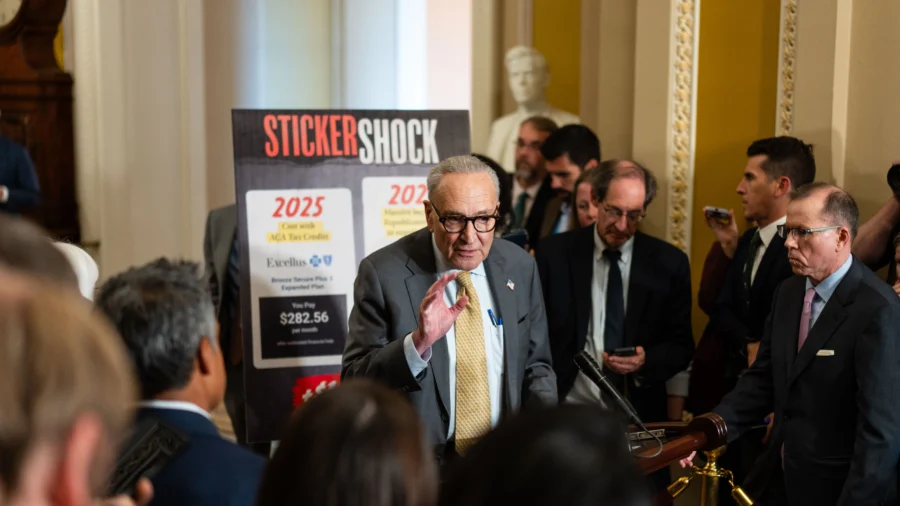
Senators have passed a bill to revoke the national emergency declaration used by President Donald Trump as the legal basis for his reciprocal global tariff measures.
Four Senate Republicans joined with Democrats to support the bill: Sens. Susan Collins (R-Maine), Mitch McConnell (R-Ky.), Lisa Murkowski (R-Alaska), and Rand Paul (R-Ky.).
In August, the United States imposed a 50 percent tariff on some Brazilian products, aiming to facilitate trade reciprocity and regulatory alignment. The two sides have been engaged in informal talks since August.
Sen. Mike Crapo (R-Idaho), speaking on the Senate floor, said: "It's no secret that for decades, countries around the globe have raised tariff and non-tariff barriers against Americans and against American businesses and have raised costs for Americans and American businesses without response by the United States.
"Trump is now responding and saying these countries need to take down their tariff and their non-tariff barriers and deal with us in fair and free trade."
But many other lawmakers, including McConnell, have said that levies are harming the United States.
“I primarily object to the Canada tariffs because I don’t think there’s an emergency that should trigger the use of this statute, but there are many other reasons I object to them, and the fracturing of this long-standing, powerful relationship is one of them,” Sen. Tim Kaine (D-Va.) said in a speech on the Senate floor.
Trump slapped an additional 10 percent tariff on existing rates for Canadian products in response to a television ad by Ontario, which used edited clips of President Ronald Reagan criticizing tariffs.
Despite the outcome, House Speaker Mike Johnson (R-La.) is unlikely to bring these resolutions to the floor for a vote.
Vice President JD Vance, following his meeting with Senate Republicans, stated that these votes are a "huge mistake," as tariffs provide the president with leverage to "put American workers first."
"They're also incredible leverage for the president ... in negotiating these trade deals overseas," Vance told reporters, pointing to recent trade developments during Trump's trip to Asia.

During his Asia tour this week, Trump finalized or put together trade agreements with Cambodia, Japan, Malaysia, Thailand, and Vietnam.
Trump also lowered U.S. tariffs on Chinese imports to 47 percent from 57 percent after what he described as "an amazing meeting" with Chinese leader Xi Jinping. The U.S. president also halved the rate of tariffs related to trade in fentanyl precursor drugs to 10 percent from 20 percent.
In exchange, Beijing will resume its purchases of U.S. soybeans and refrain from imposing rare earth export controls, Trump said.
All of this has happened because of the president’s ability to employ levies, the vice president said.
"If you look at all of the trade deals, the trade barriers that have been dropped by foreign countries on American consumers, they are happening because the president of the United States has been willing to use tariffs to give American workers and American farmers a better deal," Vance said.
These legislative efforts come ahead of a major case before the Supreme Court challenging the president's authority to introduce sweeping global tariffs using emergency powers.
On Nov. 5, the high court will hear oral argument regarding Trump's use of the International Emergency Economic Powers Act.