


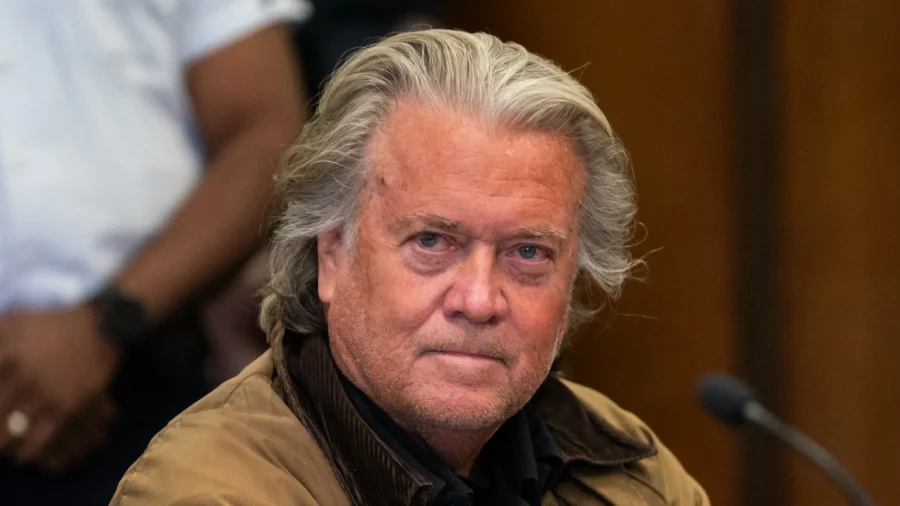
The U.S. Supreme Court cleared the way on Monday for the Justice Department to move forward with dismissing a criminal case in which Steve Bannon, an influential ally of President Donald Trump, was convicted after defying a congressional subpoena.
The justices threw out a lower court's decision to uphold Bannon's 2022 conviction for refusing to turn over documents or testify to a congressional panel that investigated the January 6, 2021, breach of the U.S. Capitol by Trump supporters.
Trump's Justice Department, in urging the Supreme Court to toss the lower court's decision, told the justices in court papers it has determined that dismissal of Bannon's case "is in the interests of justice." The department had already filed a motion to dismiss the case at the trial court level.
The Supreme Court, in a brief unsigned order, returned the case to the lower court for further consideration "in light of the pending motion to dismiss the indictment."
Bannon was convicted by a jury in Washington on two counts of contempt of Congress for failing to provide documents or testimony to a Democratic-led House of Representatives committee investigating the Capitol breach.
Bannon, 72, served as a key adviser to Trump's 2016 presidential campaign and his chief White House strategist in 2017 during Trump's first term in office before a falling out between them that was later patched up.
After the Supreme Court in June 2024 denied Bannon's request to keep him out of prison while his appeal played out, he served a four-month sentence at a low-security federal facility in Danbury, Connecticut.
Bannon was released from prison a week before Trump's victory over Democrat Kamala Harris in the 2024 election.
The U.S. Court of Appeals for the District of Columbia Circuit in 2024 upheld Bannon's conviction, prompting his appeal to the Supreme Court.
Lawyers for Bannon have raised various legal arguments to contest the subpoena, including issues related to executive privilege, a legal principle that lets a president keep certain communications private, and the congressional committee's authority to issue the subpoena.
The Justice Department declined to comment on Monday.