


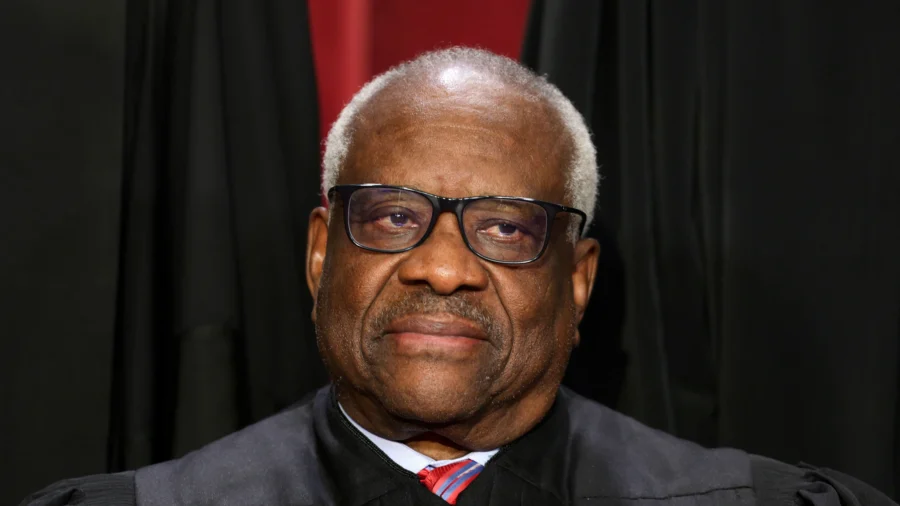
Thomas said the majority is attempting to repurpose the 14th Amendment "to protect its own set of preferred rights that the Reconstruction Congress never contemplated and that cannot find support in its text," referring to the post-Civil War era of the mid-to-late 19th century.
Further, he argued that the June 30 ruling denigrates the idea of U.S. citizenship, saying that it has been used by "foreign birth tourists and illegal aliens."
"I am not sure that today’s opinion will stand the test of time,” Thomas wrote. “The Citizenship Clause 'added greatly to the dignity and glory of American citizenship.' Today’s opinion devalues that citizenship.”
The order issued by Trump aimed to exclude children of illegal immigrants and temporary visitors from gaining automatic birthright citizenship. In 1898, the high court delivered the landmark birthright citizenship ruling in United States v. Wong Kim Ark, which effectively stated that any child born in the United States to immigrants is granted citizenship regardless of the nationality of the child’s parents.
In addition to Thomas, Justices Samuel Alito and Neil Gorsuch dissented and indicated that they would allow Trump's executive order to stand. Justice Brett Kavanaugh partially concurred with the majority in saying that he thinks the Trump administration's executive order does violate a federal statute but that the constitutionality of birthright citizenship is an open question and that the executive order doesn't violate the 14th Amendment.
“The Court today takes the extraordinary step of holding facially unconstitutional the President’s Order excluding from citizenship the children of foreign temporary visitors and illegal aliens,” Thomas said in the 91-page dissent, which is significantly longer than the majority's opinion.
Thomas indicated that he sided with the Trump administration's arguments that the 14th Amendment, ratified three years after the end of the Civil War in 1868, was intended to give citizenship to black people who were freed from slavery rather than automatically giving it to the children of immigrants.
“In doing so, the Court adds to the sad history of the Fourteenth Amendment, which was designed and understood to secure equal rights for the freed blacks but has instead been repurposed for political projects that the Reconstruction Congress did not support," he said.
Chief Justice John Roberts wrote the majority opinion and was joined by Justices Sonia Sotomayor, Elena Kagan, Amy Coney Barrett, and Ketanji Brown Jackson.
“Citizenship, then and now, was the right to have rights—to freely participate in our political community. The Framers of the Fourteenth Amendment extended that promise to ‘every free-born person in this land,’” Roberts wrote, citing congressional debate over the 14th Amendment. “We keep that promise today.”
Multiple lower courts have blocked the executive order, signed by Trump early in his presidential term last year, and it has not taken effect anywhere in the United States. The high court ruled on the president's appeal of a lower-court ruling from New Hampshire that struck down the birthright citizenship restrictions.
Birthright citizenship was the first Trump administration immigration-related issue to reach the Supreme Court for a final ruling. Since he took office, Trump has rolled out policies designed to deport large numbers of illegal immigrants, namely those with criminal records.
He has also canceled temporary protected status for hundreds of thousands of people living in the United States, bolstered U.S. border security, initiated policies encouraging illegal aliens to self-deport, and issued other rules.
In response to the June 30 ruling, Trump said, “[The ruling is] too bad for our Country, but we can easily make it up in Congress through Legislation.”
“Congress should start TODAY to work on ending expensive and unfair to our Country, Birthright Citizenship,” he wrote on Truth Social. “They will have my Complete and Total Support!”
In a previous post, he argued that “dumb judges and justices” allow wealthy women from China and elsewhere to come to the United States with the sole purpose of giving birth so that their children will be American citizens. He noted that few other countries have such a policy.
The American Civil Liberties Union (ACLU) hailed the majority opinion, saying that the “decision reaffirms a fundamental American promise—if you are born here, you are a citizen.”
“A president cannot change the Constitution by executive fiat,” ACLU National Legal Director Cecillia Wang said in a statement. “Our brave clients and our legal team stand with millions of people around our country who spoke up for one of our most cherished rights. The Constitution’s guarantee of birthright citizenship stands strong.”