


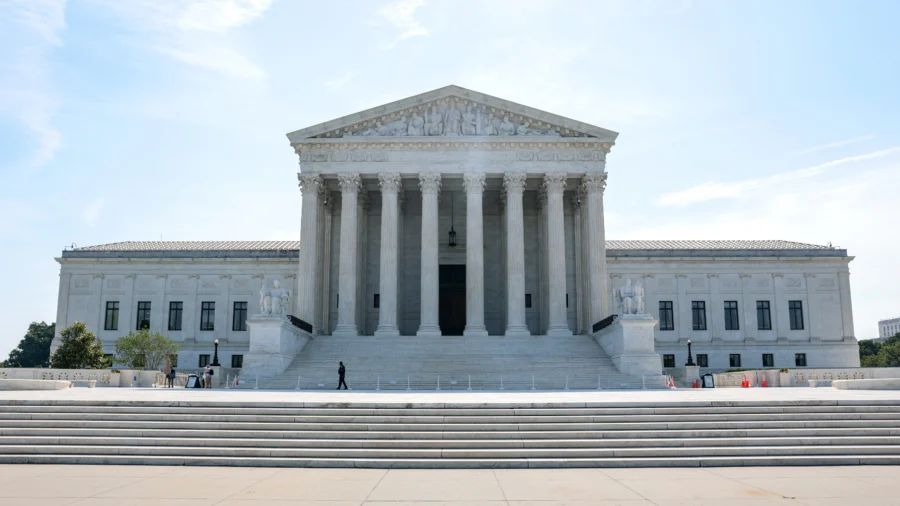
The U.S. Supreme Court on June 23 ruled 6–3 that immigration authorities were legally justified in refusing to formally admit into the country a Chinese citizen with a U.S. green card who had been charged with counterfeiting.
The legal issue in the highly technical case of Blanche v. Lau is whether the U.S. Department of Homeland Security (DHS) correctly classified the man as inadmissible because of a pending criminal charge. A lawful permanent resident of the United States since September 2007, the respondent, Muk Choi Lau, returned to the country in June 2012 after a trip to his native China.
The government-issued residency document issued to lawful permanent residents is colloquially called a green card.
Lau had been charged in May 2012 with violating New Jersey law by engaging in third-degree trademark counterfeiting.
Upon returning to the United States, he presented himself as a lawful permanent resident, but U.S. immigration authorities noted the pending charge and declined to formally admit him to the country. Instead, they granted him parole with deferred inspection, meaning he was allowed into the country subject to a later decision on his immigration status.
Lau was convicted of counterfeiting in June 2013 and sentenced to two years of probation. In March 2014, DHS moved to deport him, saying that he had been ineligible for admission in June 2012 because when he reentered the country, he had committed “a crime involving moral turpitude.”
The U.S. Department of Justice argued that an offense involving moral turpitude is a serious crime sufficient to warrant deportation.
Justices Ketanji Brown Jackson, Sonia Sotomayor, and Elena Kagan dissented.