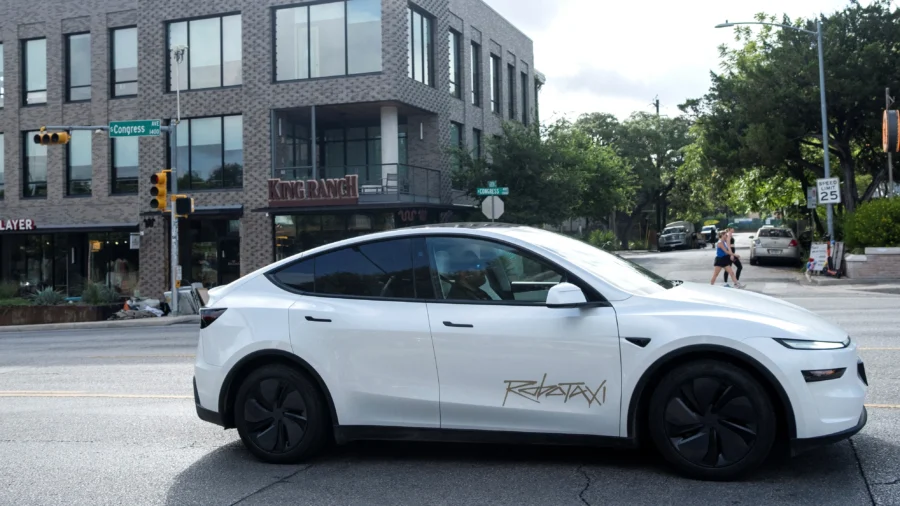
Tesla’s self-driving robotaxis began service for the first time Sunday morning in Austin, Texas. The robotaxi launch is presently limited to invite-only passengers, about 10 cars, a safety-monitor in the front passenger seat, and within a geo-fenced area in Austin.
CEO Elon Musk posted on his social media platform X on June 22 that the robotaxi was a culmination of a decade of hard work. “Both the AI chip and software teams were built from scratch within Tesla,” Musk
posted.
In the days leading up to the rollout, Tesla
invited social-media influencers to participate in the tightly controlled robotaxi test. According to Musk, the rides cost a flat fee of $4.20. Passengers also took to social-media to share videos, pictures, and their experience in the self-driving taxis.
Videos on X,
reposted by Musk, show a driverless car, with the passenger filming the empty driver’s seat as they ride in the self-driving taxi. One passenger filmed their experience from ordering the robotaxi to getting dropped off at their destination. During the test rides, a front-seat passenger was seen sitting in the passenger side acting as a safety-monitor.
As the robotaxi launch date approached in Texas, lawmakers in the state moved to enact autonomous-vehicle rules. Texas Gov. Greg Abbott (R-Texas) signed legislation
SB2807 requiring a state permit to operate self-driving vehicles on Friday.
The new Texas law regulating driverless vehicles will take effect on Sept. 1, signaling bipartisan support for cautious development of the industry. For example, a previous 2017 Texas law prohibited cities from regulating self-driving cars. With the new law, it requires companies to get approval from the Texas Department of Motor Vehicles before operating autonomous cars without human drivers.
The new law aims to protect independent contractor status, promote safety investments without concerns of employment reclassification, and clarifies legal relationships for carriers and drivers.
Texas state Rep. Pat Curry, who co-sponsored the bill,
posted on X that the signing of the bill is a big win for Texas roads. Gov. Abbott, “just signed SB2807 which I sponsored —a smart, common sense safety road map for owner operators & autonomous vehicle bill that keeps TX innovation moving and keeps our roads secure,” Curry posted on June 22.
Currently, only four states have robotaxi services: Arizona, California, Florida, and Texas. Waymo, which is Google's robotaxi, can be found driving through Phoenix, Arizona. In California, the self-driving taxis are running through San Francisco, Los Angeles, and parts of Silicon Valley. In Florida, Waymo operates in Miami. And the Waymo operates within 37 square miles of Austion, Texas, in partnership with Uber.