


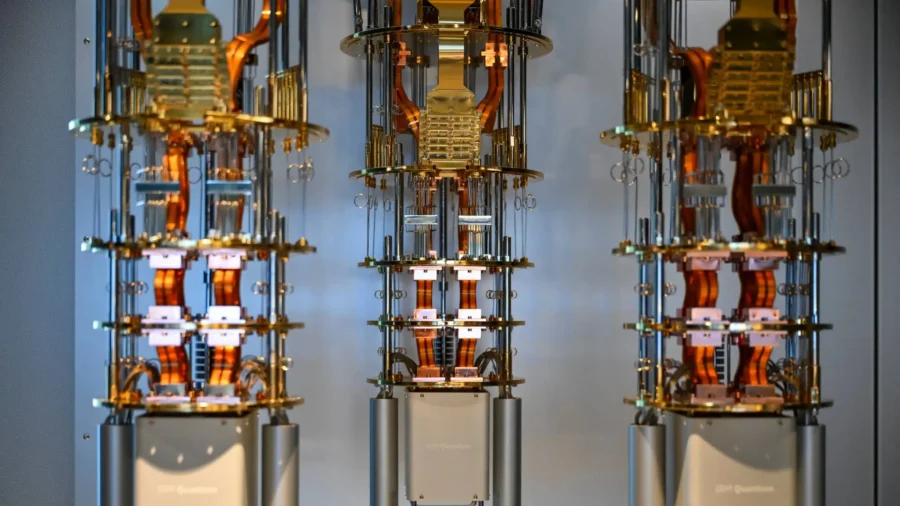
The U.S. Department of Commerce is awarding $2 billion to IBM and eight other American quantum computing companies in an effort to secure the nation’s lead in the race to build the world’s most powerful computers.
IBM is set to receive half of that amount to launch a new subsidiary called Anderon, which the company described in a statement Thursday as “America’s first pure-play quantum foundry.”
“This initiative represents one of the most significant commitments by the U.S. Government to date in quantum R&D to position the United States to manufacture most of the world’s quantum wafers,” IBM said, referring to the specialized wafers used to produce quantum computing chips.
Quantum computers process information using qubits, which rely on the laws of quantum mechanics. Because qubits are highly vulnerable to decoherence—the loss of their quantum state due to interference from their surroundings—quantum-grade wafers must meet extraordinarily high standards of purity and structural precision to support stable, reliable performance.
IBM said it would match the award by investing an additional $1 billion into Anderon, “with additional investors expected” as the company grows.
Thursday’s awards also included $375 million for contract chipmaker GlobalFoundries to build a domestic factory capable of producing components for several different types of quantum machines, according to the Commerce Department.
Other firms, including D-Wave, Rigetti Computing, and Infleqtion, will receive about $100 million each, while Diraq is set to receive up to $38 million to tackle key technical hurdles that have slowed the development of more powerful quantum computers.
The funding comes from the CHIPS and Science Act of 2022, a $280 billion package aimed at boosting domestic high-end semiconductor manufacturing, reducing reliance on overseas supply chains, and countering China’s technological influence and competition.
In exchange, the Commerce Department said it will take a “minority, non-controlling” equity stake in each company to “enhance the return for the U.S. taxpayer.”
“These strategic quantum technology investments will build on our domestic industry, creating thousands of high-paying American jobs while advancing American quantum capabilities,” Commerce Secretary Howard Lutnick said.
Investors have been pouring money into quantum computing firms because the technology is expected to solve problems beyond the reach of even the most powerful conventional supercomputers. That could lead to major advances in fields such as medicine, finance, and transportation, from designing new drugs to testing advanced car materials to simulating complex market behaviors.
According to a study by McKinsey & Company, quantum computing could generate as much as $1.3 trillion in value across these industries by 2035.
The expectations stem from the fact that quantum systems operate fundamentally differently from classical computers, which process information using bits that can exist in only one of two states at a time, either 0 or 1. A qubit, by contrast, can exist in a combination of both at the same time, allowing quantum systems to process information far more efficiently.
Quantum computing’s power can grow even further when multiple qubits are linked through a phenomenon known as “entanglement.” Under the laws of quantum mechanics, entangled qubits can become correlated in ways that dramatically expand what these systems can do at exponential scales.