


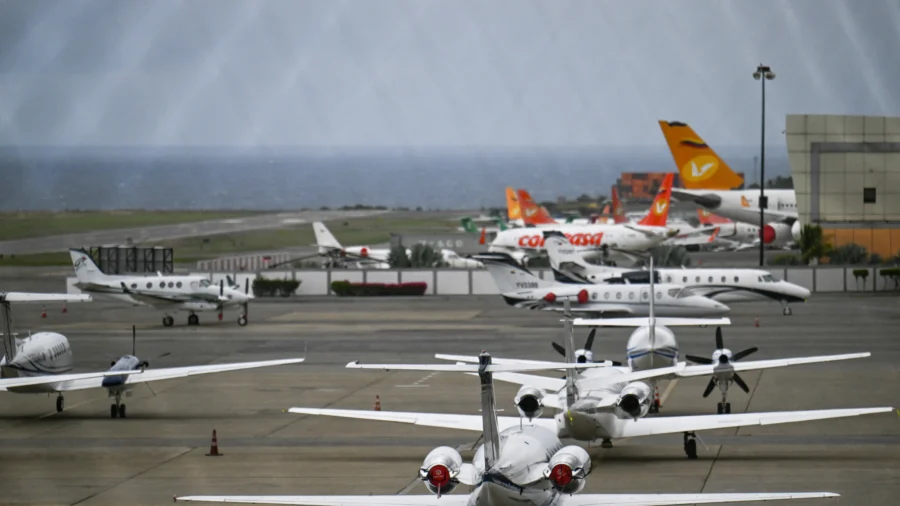
On Jan. 29, President Donald Trump announced that he had instructed the transportation secretary to reopen Venezuela's airspace to commercial flights.
Speaking to reporters during a White House Cabinet meeting on Jan. 29, Trump said he spoke with interim Venezuelan leader Delcy Rodríguez and informed her that the United States is "going to be opening up all commercial airspace over Venezuela."
Trump said U.S. citizens will soon be able to safely travel to Venezuela.
During the Cabinet meeting, Trump said oil companies are already looking into business opportunities in post-Maduro Venezuela. He said industry leaders are already “scouting it out and picking their locations.”
“And they'll be bringing back tremendous wealth for Venezuela and for the United States,” Trump said.
The president also noted the potential for Venezuelan expatriates to return to their home country.
"The people formerly of Venezuela, some want to go back, and some want to go back to visit, and they're going to be able to do that," he said.
Since capturing Maduro on Jan. 3, the Trump administration has worked with Rodríguez—Maduro’s deputy and political ally—to manage Venezuela through the transitional phase.
Testifying before the Senate Foreign Relations Committee on Jan. 28, U.S. Secretary of State Marco Rubio described signs of progress in post-Maduro Venezuela.
“I’m not here to claim to you this is going to be easy or simple," Rubio said. "I am saying that in 3 1/2, almost four weeks, we are much further along on this project than we thought we would be."
Rubio said the Trump administration had considered the possibility that Maduro’s removal would set off a violent power struggle between competing factions in Venezuela or exacerbate a migrant crisis with people fleeing the country.
“All of that has been avoided,” he told lawmakers.
In December, the United States also began blocking sanctioned oil tankers from sailing in and out of Venezuela. Since Maduro’s removal, the Trump administration has arranged for a mechanism for Venezuela to resume oil exports, with the proceeds to go into an account managed by the U.S. Treasury.
As he spoke with lawmakers on Jan. 28, Rubio said Venezuela’s interim authorities have already returned one seized oil tanker to Venezuela to channel the ship’s cargo through the U.S.-managed mechanism for oil sales.