


Trump has also accused Canada of failing to manage its forests, saying that the economic cost of the pollution should be added to current tariffs on the country.
“I will call the Prime Minister during the day to find out what they are going to do about it,” he added.
“We are in direct communication with the Canadian government, as well as federal, state, local, and Tribal partners,” he said.
The EPS warns that wildfire smoke poses health risks both outdoors and indoors, as it can enter homes through doors, windows, and ventilation systems.
While most people recover quickly from smoke exposure, the agency advises residents to take precautions when air quality is at unhealthy or hazardous levels.
Children, older adults, and people with heart or lung disease are most at risk from the effects of smoke.
Trump called Canada's handling of its forests "Willful Negligence," and said the smoke has become an annual problem that costs the United States billions of dollars, and that those costs should be reflected in higher tariffs on Canada.
“Nothing has changed except that our patience has run out,” they wrote, adding that Michigan residents were again under air quality alerts and hospitals were treating children, dialysis patients, and older adults for smoke-related effects.
Moreno said Canada has failed to invest in wildfire prevention measures, including forest thinning, fuel reduction, prescribed burns, and stronger enforcement of arson laws.
Smoke from more than 100 active wildfires in Ontario, along with fires burning in Minnesota's Boundary Waters, pushed unhealthy air across parts of the Great Lakes, Northeast, and Mid-Atlantic on Friday.
On Friday, communities in Minnesota, Michigan, and Illinois closest to the Canadian border and the Boundary Waters Canoe Area Wilderness in Minnesota again registered some of the worst air quality in the world, according to IQAir, an air quality monitoring website.
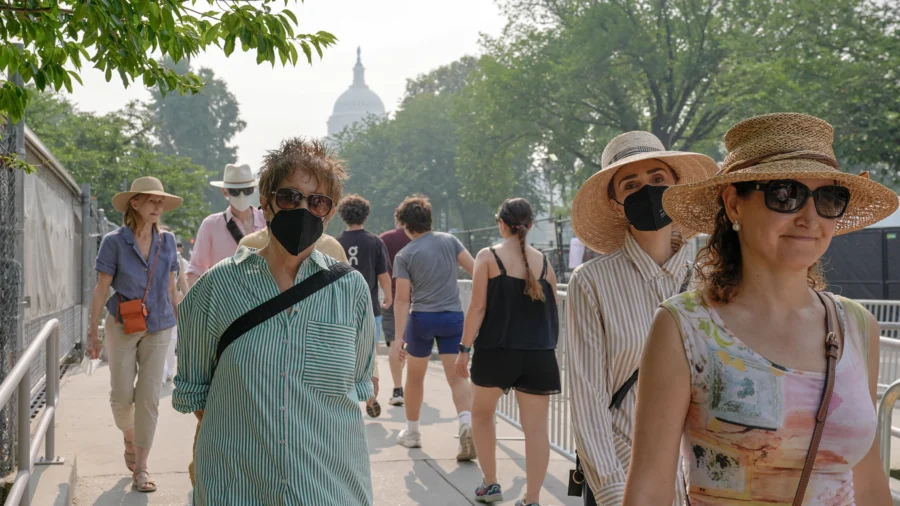
Washington, D.C., was shrouded in thick haze, while air quality alerts remained in effect across multiple states. National Weather Service forecasters warned that smoke could continue affecting portions of the country for at least another week, depending on wind patterns.
The Canadian fires have also forced evacuations in northern Ontario. According to the Canadian Broadcasting Corporation (CBC), fires have displaced residents, including members of Namaygoosisagagun First Nation, also known as Collins First Nation, after flames destroyed homes in the community.
Zeldin said the EPA would continue pressing senior Canadian officials to extinguish the fires as quickly as possible.
“EPA will do everything in the agency’s authority to continue to protect human health and the environment throughout this event. Providing clean air for all Americans remains a top priority of the Trump EPA,” he said.