


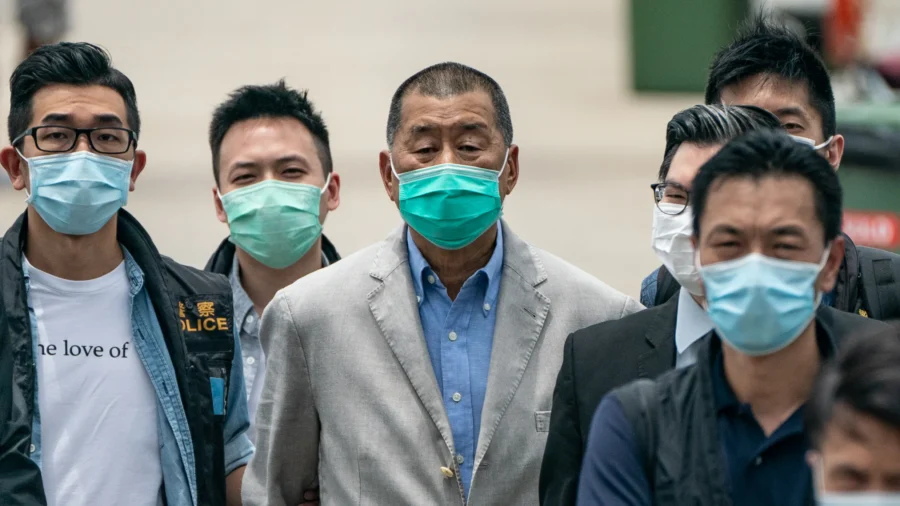
President Donald Trump said on May 11 that he plans to raise the cases of media entrepreneur Jimmy Lai and pastor Ezra Jin during his upcoming meeting with Chinese leader Xi Jinping.
“I’ll bring them both up,” Trump told reporters in the Oval Office.
"Jimmy ... caused lots of turmoil for China. He tried to do the right thing," he added. "He wasn't successful. Went to jail, and people would like him out. And I'd like to see him get out, too."
Trump previously discussed Lai’s case with Xi during their October 2025 meeting in South Korea, according to comments the president made during a May 4 interview with radio host Hugh Hewitt.
The founder of the now-shuttered pro-democracy newspaper Apple Daily, Lai was convicted in December 2025 on two counts of “conspiracy to collude with foreign forces” under the national security law, along with a third sedition charge stemming from a colonial-era statute. He pleaded not guilty to all charges.
Lai’s lengthy sentence has renewed international criticism over Beijing’s tightening control over Hong Kong and the erosion of freedoms once promised to the city under the “one country, two systems” framework established after Britain transferred Hong Kong to Chinese rule in 1997.
Both Hong Kong and Chinese authorities have rejected those criticisms, describing them as interference in China’s internal affairs. In a May 1 statement, Hong Kong officials defended Lai’s conviction, accusing him of using journalism to cause harm to the country.
Trump also said he intends to discuss the case of Ezra Jin, a pastor associated with Zion Church, one of China’s largest underground “house churches” operating outside state control.
"And there's another gentleman, a pastor, as you know, with a beautiful daughter and son-in-law, that would like to see him get out. I'm going to bring his name up," the president said.
His arrest was part of a broader clampdown that targeted church leaders in Beijing and at least five other provinces.
House churches in China operate independently of the state-approved religious system, often placing them at odds with authorities. Under Xi’s leadership, the Chinese regime has significantly increased restrictions on independent religious groups over the past decade.
Human rights organizations and religious freedom advocates have reported church closures, Bible confiscations, and intensified surveillance of worshippers as part of Beijing’s wider effort to “sinicize” religion—aligning religious practices more closely with the CCP’s political ideology and authority.