


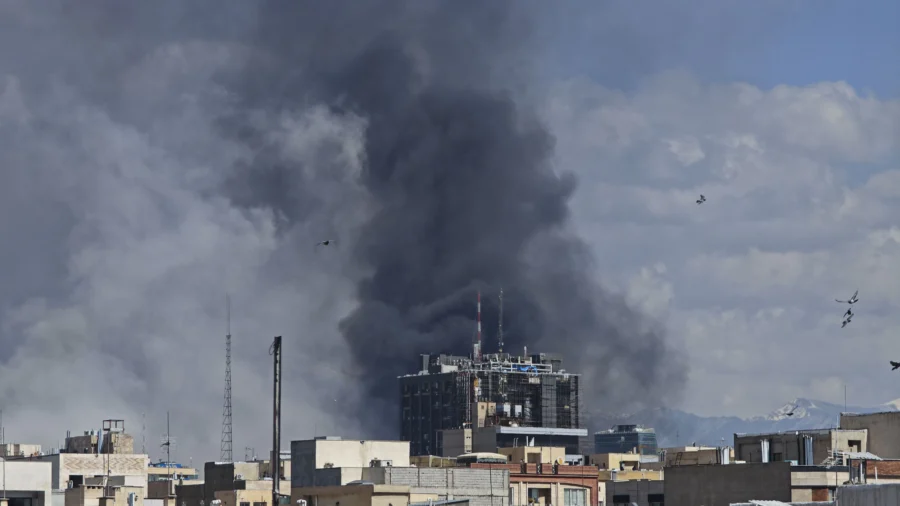
President Donald Trump has said he is advising Tehran to make a deal, saying he is losing patience with Iran.
“I’m not going to be much more patient,” Trump said in an interview aired on May 14 on Fox News’ “Hannity” program.
“They should make a deal. Any sane person would make a deal. But they might be crazy.”
The president also suggested that delays in communication were a result of instability in the political structure in Tehran.
“They make a deal and then the next day, like we waited five days for a letter that should have been there in one hour. I said, ‘Where is the letter?’ They are having a lot of turmoil,” he said.
Trump was in China this week on a state visit, where he met with Chinese leader Xi Jinping.
“He said he’s not going to give military equipment,” he said. “That’s a big statement.”
Oil Prices Up 3 Percent
Oil prices were up 3 percent on May 15 after Trump said his patience with the Iranian regime was running out.Brent crude futures gained $2.50, or 2.4 percent, to $108.22 a barrel by 11:39 GMT. U.S. West Texas Intermediate futures were also up $2.86, or 2.4 percent, at $104.03.
Over the week, Brent has risen 6.8 percent and WTI 9 percent as a result of the uncertainty over the stability of the ceasefire.
Movements of oil shipments through the Strait of Hormuz have been slowed since the United States and Israel launched a war on Iran and Tehran imposed an effective blockade on the Strait of Hormuz, a vital route for global oil shipments.
Iranian Threat ‘Significantly Degraded’
This week, a senior U.S. admiral told a U.S. Senate committee that Iran’s capabilities to threaten U.S. forces and regional interests had been “substantially degraded” since the start of Operation Epic Fury.CENTCOM Commander Adm. Brad Cooper on May 14 delivered testimony on the command’s posture to the U.S. Senate Committee on Armed Services.
In a witness testimony submitted before the hearing, he said, “In less than 40 days of major combat operations, USCENTCOM forces systematically dismantled what Iran spent four decades and tens of billions of dollars building.”
He said that the regime in Iran “can no longer reliably arm or resupply” with advanced weaponry proxies in the region, including Hezbollah in Lebanon, the Houthis in Yemen, Hamas in the Gaza Strip, or militia groups in Iraq.
Cooper described Iran’s air and air defense forces as “functionally and operationally irrelevant.”
In terms of naval power, Cooper said that U.S. forces had destroyed 161 vessels across 16 classes of warships, “effectively crippling the regime’s ability to operate.”
“We eliminated more than 90 percent of Iran’s once-massive inventory of over 8,000 naval mines, with more than 700 airstrikes on Iranian naval mine targets,” he said.
“In sum, Iran’s navy can no longer claim to be a maritime power, and it cannot project into the Gulf of Oman or the Indian Ocean.”