


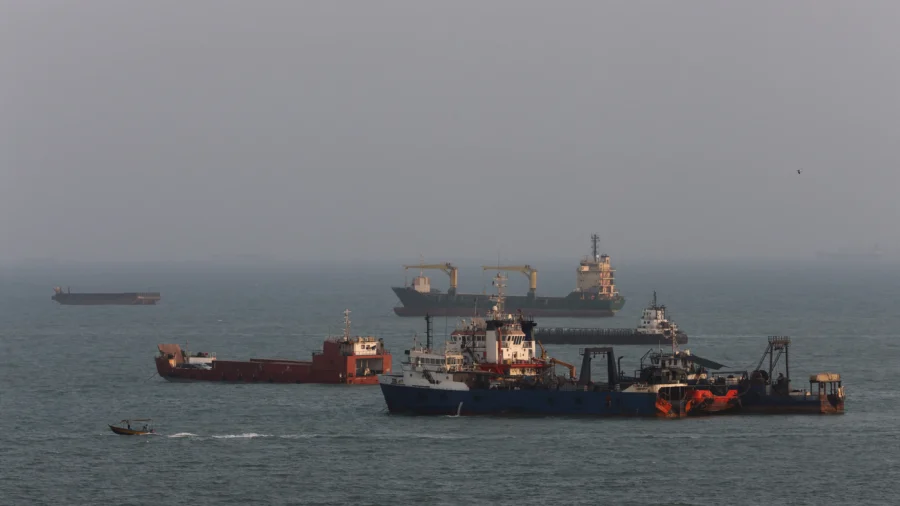
U.S. President Donald Trump on Wednesday said the United States is in control of the Strait of Hormuz.
"The U.S.A. has total control over the Strait of Hormuz. I THINK WE WILL KEEP IT! Our Naval Blockade is being called, by everyone, “A WALL OF STEEL,” and there is nothing Iran can do about it," he wrote on his Truth Social platform.
On Tuesday night, Trump insisted that the U.S. military has “total control” over the Strait of Hormuz.
“Iran is going fine, going just absolutely fine,” he told reporters after a trip to Ohio. “We totally control the Strait of Hormuz. We have control over it. Nobody else. Only us,” Trump said.
Central Command said it has redirected 55 commercial vessels attempting to run the blockade, disabled three noncompliant vessels and boarded two. The U.S. Navy currently has more than 15 warships, including two aircraft carriers and an amphibious assault ship, stationed in the waters of the Arabian Sea.
The U.S. military said Tuesday that its forces fired on a Panamanian-flagged ship in the Gulf of Oman that tried to evade the American blockade on Iranian ports. The move came as U.S. President Donald Trump tries to keep economic pressure on the Islamic Republic.
Oil Prices Dip as Investors Weigh Lower Demand Forecasts Against US-Iran Talks Deadlock
Oil prices fell in volatile trading on Wednesday, having earlier traded $1 higher, after forecasters cut projections for 2026 global oil demand, while attacks on ships in the Middle East continued as talks to end the Iran war hit an impasse.Brent futures were down 49 cents, or 0.55 percent, at $88.42 a barrel by 1315 GMT. U.S. West Texas Intermediate (WTI) crude fell 25 cents, or 0.3 percent, to $82.95.
The Organisation of Petroleum Exporting Countries lowered its world oil demand growth forecast for 2026 to 580,000 barrels per day, it said in its monthly oil market report.
Rival forecaster the International Energy Agency, meanwhile, slashed its own 2026 demand projections and now expects a 1.6 million bpd contraction this year. However, the Paris-based agency is also predicting a 4.3 million bpd drop in supply this year, and an overall 2026 deficit of around 1.27 million bpd.
Adding to downward pressure on prices, U.S. crude inventories rose sharply last week, according to preliminary American Petroleum Institute data, which if confirmed later on Wednesday by the Energy Information Administration could ease market concerns about supply tightness, Haitong Futures analysts said in a note.