


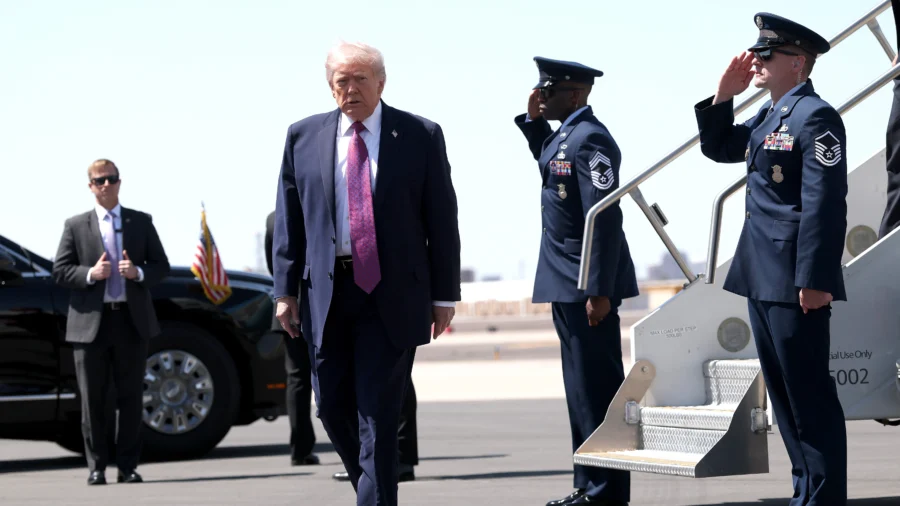
President Donald Trump said on April 17 that talks aimed at ending the war in Iran are ongoing and will carry on over the weekend, and there had been some "good news" about Iran.
“A lot of good things are happening, and that includes Lebanon, too.”
When asked about reports of Iran claiming that “significant differences” remain in the talks with the United States, Trump said those issues could be worked out.
“Well, there could be. Let’s see what happens. If there are, we'll have to straighten it out. But I don't think there's too many significant differences,” he said.
Trump said the U.S. military would end its blockade of Iranian ports once an agreement is signed between the two nations to end the war, under which Iran will have to abandon its nuclear weapons program and fully reopen the Strait of Hormuz, a critical oil transit waterway.
“We had some pretty good news 20 minutes ago, but it seems to be going very well in the Middle East with Iran,” he said. “You'll hear about [it]. I just think it's something that should happen. It's something that only makes sense to happen, and I think it will. We’ll see what happens.”
The two-week ceasefire between the United States and Iran, which began April 8, is due to expire next week. Trump said the U.S. military operations on Iran could resume if no deal is reached by the deadline.
“Maybe I won’t extend it. So you have a blockade and unfortunately, we’ll have to start dropping bombs again,” he said.
The blockade was imposed earlier this week after Iran restricted access to the strait amid escalating tensions tied to the conflict in Lebanon, where Israeli forces targeted Iran-backed terrorist group Hezbollah. U.S. officials have said the Pakistan-brokered ceasefire did not include Lebanon, but Tehran had described its restrictions on the strait as a response to the Israeli attacks, which the regime viewed as violations of the ceasefire.
“We are currently verifying the recent announcement related to the reopening of the Strait of Hormuz, in terms of its compliance with freedom of navigation for all merchant vessels and secure passage using the IMO established traffic separation scheme,” IMO Secretary-General Arsenio Dominguez said in a post on social media.