


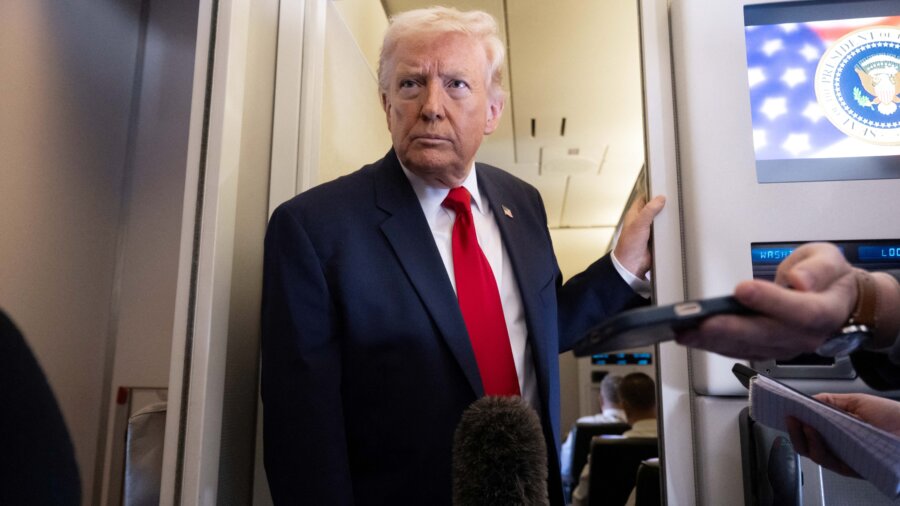
President Donald Trump said on March 15 that he may delay a planned meeting with Chinese leader Xi Jinping and expected Beijing to assist in keeping the Strait of Hormuz open.
“It’s only appropriate that people who are the beneficiaries of the Strait will help to make sure that nothing bad happens there,” the president said in an interview with the Financial Times.
Trump said he would like to know China’s position on the matter before his planned visit to Beijing at the end of the month to meet Xi.
“I think China should help too because China gets 90 percent of its oil from the Straits [sic],” he said of China’s reliance on the Strait of Hormuz.
Trump did not indicate how long the meeting could be delayed. The reason for any delay remains unclear.
Trump also urged NATO allies to assist in keeping the strait open, saying that NATO’s future could be at risk if allies fail to respond.
The president suggested that allies could contribute to sending minesweepers, as he noted Iran has been putting mines in the water to create nuisance.
“We have a thing called NATO,” Trump told the news outlet. “We didn’t have to help them with Ukraine. Ukraine is thousands of miles away from us ... but we helped them. Now, we’ll see if they help us. Because I’ve long said that we’ll be there for them but they won’t be there for us. And I’m not sure that they’d be there.”
The White House did not respond to a request for comment by publication time.
The escalating conflict in the Middle East has caused many tankers to stop transiting the Strait of Hormuz, a vital maritime chokepoint for global oil and gas shipments.
Trump told reporters on March 15 that he asked about seven countries who rely heavily on the Strait of Hormuz to help secure the shipping route.
“I’m demanding that these countries come in and protect their own territory, because it is their territory,” he told reporters aboard Air Force One. “It’s a place from which they get their energy and they should come and they should help us protect it.”
Trump did not name the seven countries. He noted that the Strait of Hormuz is vital to those countries but less so for the United States because of its own oil resources.
Trump said his administration is discussing cooperation with other countries on policing the waterway but provided no details about the negotiations.
He also declined to indicate whether China has signaled willingness to cooperate.
“I mean, I can’t really say for sure, but China is an interesting case study,” he said. “So I said, ‘Would you like to come in,’ and we’ll find out. Maybe they will, maybe they won’t. You know, there’s some other deeper reasons why they may not. They should come in, in my opinion.”
A spokesperson for the Chinese embassy said on March 15 that “all parties have the responsibility to ensure stable and unimpeded energy supply” and that China would “strengthen communication with relevant parties” for de-escalation.
Meanwhile, Iranian Foreign Minister Abbas Araghchi told CBS on March 15 that Tehran has been approached by “a number of countries” seeking safe passage for their vessels in the Strait of Hormuz, but said any decision will be made by the Iranian military.
Aragchi said that Iranian forces have allowed “a group of vessels” from different countries to pass the waterway but declined to name the countries.
“We are open to countries who want to talk to us about the safe passage of their vessels,” Araghchi told the news outlet.
Japanese Prime Minister Sanae Takaichi said on March 16 that Japan, constrained by its war-renouncing constitution, has no immediate plans to send military forces to escort ships in the Middle East region.
Takaichi said her government is examining potential responses to the situation in the Strait of Hormuz within its legal limits.
"We have not made any decisions whatsoever about dispatching escort ships. We are continuing to examine what Japan can do independently and what can be done within the legal framework," Takaichi told parliament.
The Strait of Hormuz is one of the world’s most important energy chokepoints. According to the U.S. Energy Information Administration, roughly 20 million barrels of oil per day moved through the waterway in 2024, which is equivalent to about 20 percent of global petroleum liquids consumption.