


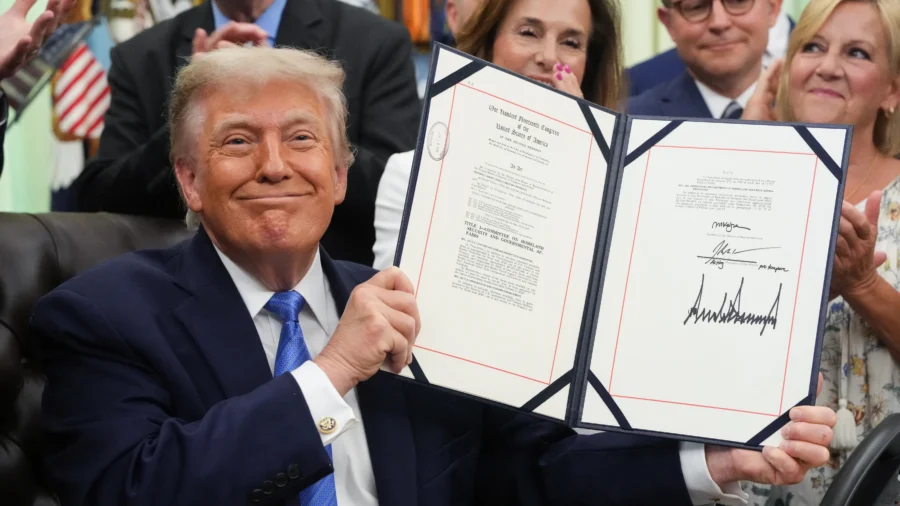
President Donald Trump on June 10 signed a $72 billion bill on June 10 to fund Immigration and Customs Enforcement (ICE) and Border Patrol.
The measure, known as the Secure America Act, funds ICE and Border Patrol through Jan. 20, 2029, which will be the end of Trump’s term.
Trump’s signature brings to a close a 116-day dispute over immigration funding. Democrats had withheld support for additional ICE and Border Patrol funding unless reforms were included following the fatal shootings of two U.S. citizens in Minneapolis involving immigration agents.
The legislation provided $38 billion to support immigration enforcement efforts, including funding for hiring, training, equipping, and compensating ICE personnel. Of that amount, $7 billion was designated for Homeland Security Investigations, while the remaining $31 billion was directed toward enforcement activities such as expanding the number of immigration attorneys, assisting local law enforcement agencies that work with ICE, and purchasing equipment like body cameras.
In addition, the bill set aside $22 billion for the Border Patrol to recruit, train, pay, and equip agents and staff. Roughly $13 billion of that funding was earmarked specifically for immigration enforcement operations.
The law also allocated $5 billion for border security technology and screening systems, including artificial intelligence tools. Another $350 million was designated for enforcement activities in jurisdictions that do not formally cooperate with ICE.
Following House passage of the legislation, House Speaker Mike Johnson (R-La.) said that Democrats will not be able to defund ICE and Border Patrol for the next few years.
“All that Democrats have achieved by their shutdown is a useful reminder to the American people of their support for open borders and keeping criminal illegal immigrants in American communities—policies that have been soundly rejected by the American people over and over again,” he said in a statement emailed to reporters. “We hope this episode serves as a future reminder to Democrats that when they shut the government down, they will receive less than nothing in return.”
House Majority Leader Steve Scalise (R-La.) said that the bill was in support of law enforcement.
“Make no mistake, if you’re voting yes, you’re not only voting to secure America’s border, you’re voting to fund law enforcement,” Scalise said. “And if you vote no, you are voting to defund the police.”
House Minority Leader Hakeem Jeffries (D-N.Y.) criticized the measure.
“Republicans have now come back for more, to give ICE and Donald Trump’s violent mass deportation machine another $70 billion blank check, with no oversight, no accountability, and no guardrails,” he said.
The funding arrives at a critical moment for the Department of Homeland Security, which underwent a leadership change in March when Trump replaced Kristi Noem with Markwayne Mullin.
Although Mullin has pledged to keep the department out of the spotlight, the administration continues to face pressure from immigration hardliners to fulfill Trump’s campaign pledge to carry out the largest deportation effort in U.S. history.
Following that announcement, Senate Republicans released updated legislative text on June 3, removing both the compensation fund and $1 billion that had been designated for a White House ballroom project and security upgrades.
Legislation approved in April to fund most of the Department of Homeland Security, excluding ICE and the Border Patrol, contained measures to finance the purchase of body cameras, strengthen congressional oversight of detention facilities, and require de-escalation training for officers and agents.
Funding for ICE and the Border Patrol was handled separately after Republicans and Democrats were unable to agree on broader immigration and enforcement reforms. As negotiations stalled, the Department of Homeland Security experienced a shutdown that lasted a record length of time.
The new funding is in addition to the almost $140 billion that ICE and Customs and Border Protection got last year as part of the One Big Beautiful Bill Act.