


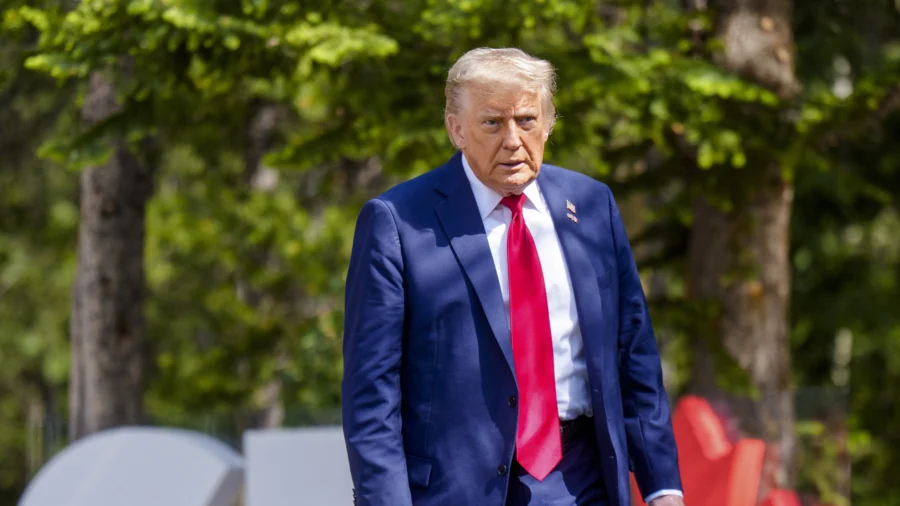
President Donald Trump on Tuesday called for the Iranian regime’s “unconditional surrender” in the Israel–Iran war and threatened the life of Iran’s supreme leader if he orders missile strikes against civilians or American troops.
In a series of messages on social media on June 17, Trump said “we” have full control of Iranian airspace and stated that the United States knows “exactly where” Iranian Supreme Leader Ali Khamenei is hiding—calling him an “easy target” but saying he would not be killed, “at least not for now.”
“We know exactly where the so-called ‘Supreme Leader’ is hiding. He is an easy target, but is safe there,” Trump wrote. “We are not going to take him out (kill!), at least not for now. But we don’t want missiles shot at civilians, or American soldiers. Our patience is wearing thin.”
A request for clarification sent to the White House on whether Trump’s posts reflect direct U.S. military involvement in Iranian airspace—and imply possible escalation—was not immediately returned. In response to a similar inquiry, the Pentagon deferred to the White House.
The president's Tuesday remarks dovetail with statements made on June 16 by several Israeli officials, who declared the establishment of air superiority over Iran.
Israeli Prime Minister Benjamin Netanyahu said on Monday that Israel's control of Iranian airspace was "a game-changer," while national security adviser Tzachi Hanegbi said pilots could operate "against countless more targets" over Tehran, thanks to the fact that Iran's air defense systems have been compromised.
Meanwhile, Trump's Tuesday remarks indicating that the United States may be getting more directly involved in the conflict come amid questions about whether Israel will be able to completely knock out Iran's nuclear program without Washington joining the campaign with strategic bombers that can drop ordnance able to penetrate sites buried deep underground.
Emily Harding of the Washington-based Center for Strategic and International Studies told Reuters that it is widely assumed that Israel cannot on its own completely eliminate the deepest buried parts of Iran's nuclear program.
However, "Israel has strongly hinted that it has more capability than that conventional wisdom would suggest," she said. "For example, the ability to operate freely over the target allows for multiple sorties that could do a lot of damage."
Israel has struck multiple Iranian nuclear sites in recent days, but has so far failed to destroy the Fordo uranium enrichment facility, located deep underground. Military analysts say taking the facility out would likely require the GBU-57 Massive Ordnance Penetrator—a 30,000-pound bunker-busting bomb currently deliverable only by the U.S. B-2 stealth bomber. Israel does not possess either the munition or the aircraft required to deploy it.
Some experts argue that only boots on the ground will be able to finish the job of dismantling Iran's nuclear weapons ambitions. Andreas Krieg, a senior lecturer at the School of Security Studies at King's College London, told Reuters that Israel has achieved "quite a lot of operational and tactical successes" in its campaign thus far, but that "translating that into a strategic success will require more than what air power can deliver."
Krieg said even the heaviest U.S. bunker-busting bombs might struggle to penetrate Iran's deepest sites, suggesting special, commando-style forces might be needed on the ground.
The regime in Iran is “very weak” and could well collapse as a consequence of Israel's military actions, Netanyahu said, adding that given the opportunity, “80 percent of the people would throw these theological thugs out."
“We’re geared to do whatever is necessary to achieve our dual aim, to remove ... two existential threats—the nuclear threat and the ballistic missile threat,” Netanyahu told Fox News, adding that Israel is trying to “protect the world from this incendiary regime.”