


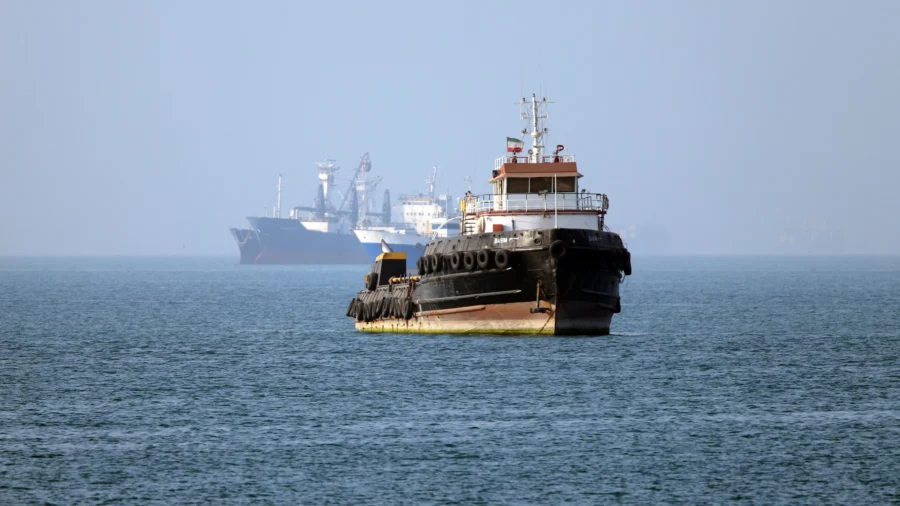
Iran carried out strikes on an Emirati oil port amid a U.S. operation to reopen the Strait of Hormuz on May 4, testing the ceasefire between Washington and Tehran.
U.S. President Donald Trump stopped short of saying that the ceasefire has been violated.
“They were shot down for the most part,” Trump told ABC News. “One got through. Not huge damage.”
The global energy markets have been in upheaval since Iran blocked the Strait of Hormuz, a waterway that handled roughly one-fifth of the world’s oil and liquefied natural gas exports before the war.
More than two months after the United States and Israel launched an air campaign against Iran on Feb. 28, Tehran has effectively shut the strait to most foreign shipping, allowing passage largely only to its own vessels. Since last month, Washington has also imposed a blockade on ships entering or leaving Iranian ports.
In a post on Truth Social on May 3, the president announced that “Project Freedom,” an effort to free up ships stranded by the strait’s closure, would begin on the morning of May 4.
The Epoch Times was unable to independently confirm the full conditions in the strait on May 4, as the opposing sides continued to issue conflicting accounts.
There was no immediate evidence that significant numbers of merchant vessels were attempting new crossings, and major shipping firms indicated that they would likely wait for a formal cessation of hostilities before resuming transit.
At least in the short term, commercial traffic has not rebounded, while Iran has responded with an intensified show of force and warnings that any further escalation could trigger fresh strikes against neighboring states.
The U.S. military said two American merchant ships successfully passed through the strait, although it did not specify when the transit occurred. Iran rejected that account.
In a post on X on May 4, U.S. Central Command (CENTCOM) said several Navy guided-missile destroyers were operating inside the Persian Gulf in support of the mission and that two U.S.-flagged merchant vessels had crossed the strait and were “safely headed on their journey.”
CENTCOM did not identify the naval escorts or the merchant ships, nor did it provide a timeline for the reported passage.
Iran’s Islamic Revolutionary Guard Corps countered that no commercial ships had crossed the strait in recent hours and dismissed the U.S. assertions as false.
Earlier, Tehran said its forces fired on a U.S. warship nearing the strait, causing it to withdraw. An initial Iranian statement claimed that the vessel had been struck, but Washington denied that, and Iranian officials later characterized the incident as warning shots.
The U.S. military has destroyed six Iranian small boats and intercepted cruise missiles and drones launched by Tehran, as it carries out an operation aimed at keeping shipping lanes open through the Strait of Hormuz, U.S. Adm. Brad Cooper, head of CENTCOM, said on May 4.
Cooper said he had “strongly advised” Iranian forces to stay clear of U.S. military assets during the operation. He noted that a U.S. blockade of Iran—restricting vessels from entering or leaving Iranian territory—remains in place and is performing better than expected.
The warning, delivered by Iranian commanders and lawmakers on May 4, comes as the United States prepares to send thousands of personnel and military assets for “Project Freedom.” The mission aims to restore the flow of maritime traffic through one of the world’s most vital energy routes.
Maj. Gen. Ali Abdollahi, who leads Iran’s central command, said in remarks broadcast by state media that Iran would target “any foreign armed force” attempting to approach or enter the strait, with particular emphasis on the United States.
Meanwhile, the United Arab Emirates reported a fire at an oil facility in the Port of Fujairah following an Iranian drone strike. Fujairah sits beyond the Strait of Hormuz, making it one of the few Middle Eastern oil export hubs accessible without transiting the choke point.
Emirati air defense intercepted 12 ballistic missiles, three cruise missiles, and four unmanned aerial vehicles, according to the UAE Ministry of Defense.
Oil prices surged by more than 5 percent amid choppy trading after reports that Iranian attacks had intensified.
In his May 3 social media post, Trump offered few specifics on how the U.S. Navy would ensure that commercial vessels could pass through the strait.
Iran’s unified command responded by instructing commercial ships and oil tankers that they must coordinate transit with Iranian armed forces.
“We have repeatedly said the security of the Strait of Hormuz is in our hands. ... We warn that any foreign armed forces, especially the aggressive U.S. Army, will be attacked if they intend to approach and enter the Strait of Hormuz,” the command said.
The United States and Israel halted their bombing campaign against Iran four weeks ago, and U.S. and Iranian officials subsequently held one round of direct talks. However, efforts to arrange additional meetings have not succeeded.
Iranian state media reported on May 3 that Washington had delivered its response to a 14-point Iranian proposal through Pakistan and that Tehran was reviewing it. Neither side disclosed details.
Under Tehran’s proposal, discussions over its nuclear program would be deferred until after an agreement is reached to end the war and settle the confrontation over shipping. Trump said over the weekend that he was still considering the offer but was likely to reject it.