

UK Spy Chief Warns of Narrowing Window to Counter China and Russian Threats

The UK’s top cyber official has issued her urgent warning on the digital threats facing Western allies.
Published: 5/27/2026, 2:25:30 PM EDT
UK Spy Chief Warns of Narrowing Window to Counter China and Russian Threats
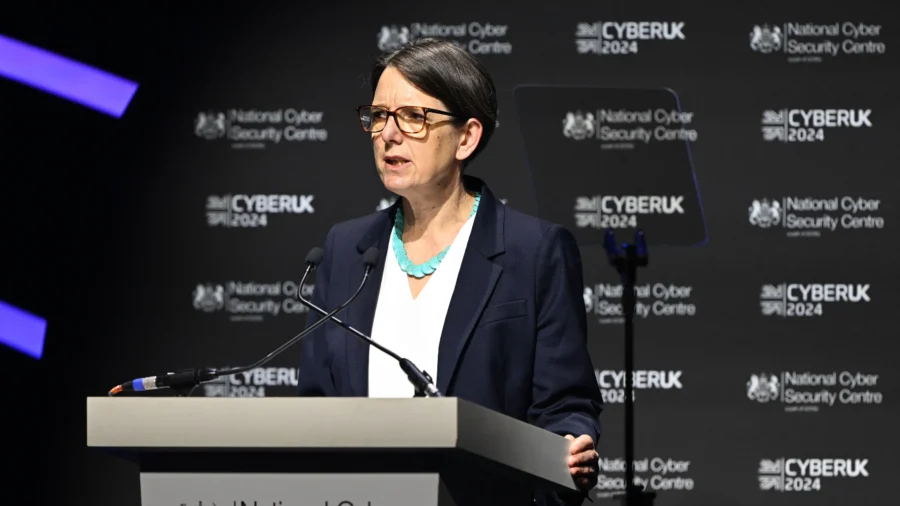
Anne Keast-Butler, director of GCHQ, speaks during the CYBERUK 2024 at Birmingham ICC Arena in Birmingham, England, on May 14, 2024. (Matthew Horwood for CYBERUK via Getty Images)

The British spy chief issued a warning that security threats from China and Russia are intensifying, declaring that the UK and its allies have reached a “moment of consequence.”

Delivering her inaugural annual address on Wednesday at Bletchley Park—the historic World War II codebreaking center—GCHQ Director Anne Keast-Butler said that the West is navigating a “new era of radical uncertainty, contested geopolitics, and rapidly changing technology,” which she described as “a space between peace and war.”
“The ground beneath our feet is shifting,” Keast-Butler warned, “and shifting fast.” She said that due to China’s expansion across its intelligence, cyber, and military agencies, time is running out for Western allies to collaborate effectively to maintain their competitive edge.

The Multi-Front Cyber and AI Challenge from Beijing

The GCHQ chief's remarks build upon a series of recent, highly specific intelligence disclosures regarding Beijing’s state-sponsored cyber operations.
At the CYBERUK 2026 annual security conference last month, British officials revealed that Chinese intelligence services have demonstrated an “eye-watering level of sophistication” in their digital campaigns.
For the first time, officials publicly confirmed a massive 2025 Chinese infiltration campaign targeting global critical networks, codenamed “Salt Typhoon.” This systemic threat landscape was initially detailed in October 2025 within the National Cyber Security Centre’s (NCSC) Annual Review 2025 report.
This British assessment closely aligns with recent escalations in Washington. On April 23, the White House Office of Science and Technology Policy (OSTP) issued a policy memorandum formally characterizing the actions of Chinese artificial intelligence laboratories as “deliberate, industrial-scale campaigns.”

According to U.S. intelligence, Chinese entities utilized tens of thousands of fraudulent accounts—leveraging commercial proxy networks—to bypass regional restrictions and conduct tens of millions of automated, high-frequency queries to systematically "distill" and clone frontier American AI models, including GPT-4 and Claude.

The Chinese Foreign Ministry and state media have aggressively pushed back against these allegations, dismissing them as entirely baseless.

The Escalating Russian Hybrid Threat

Keast-Butler also warned of the Kremlin's widening asymmetric campaign, saying that Russia is actively “scaling up its daily hybrid activity against the UK and Europe.”

Hybrid warfare blends traditional military muscle with covert destabilization tactics—including cyberattacks, sabotage, disinformation, and targeted assassinations. This strategy aims to erode an adversary's strength from within while deliberately avoiding a full-scale declaration of war.

Russia is “relentlessly targeting critical infrastructure, democratic processes, supply chains and public trust.” She said.

Keast-Butler highlighted GCHQ’s intensive cooperation with international partners to “degrade and reduce the Russian threat.”

She revealed that British intelligence operations are actively working to disrupt “Russia’s efforts to smuggle Western tech, fending off cyberattacks, and countering reckless sabotage and assassination attempts.”

These intelligence warnings follow tangible physical provocations in Europe. UK Defence Secretary John Healey recently revealed that Royal Navy and NATO assets successfully tracked three Russian submarines systematically hovering over vital undersea fiber-optic and energy cables in British waters.

Addressing domestic vulnerabilities, the GCHQ director made it clear that national defense can no longer be left solely to government agencies. She called for a sweeping, coordinated effort stretching “from boardrooms to living rooms” to treat cybersecurity with “ten times more urgency.”