


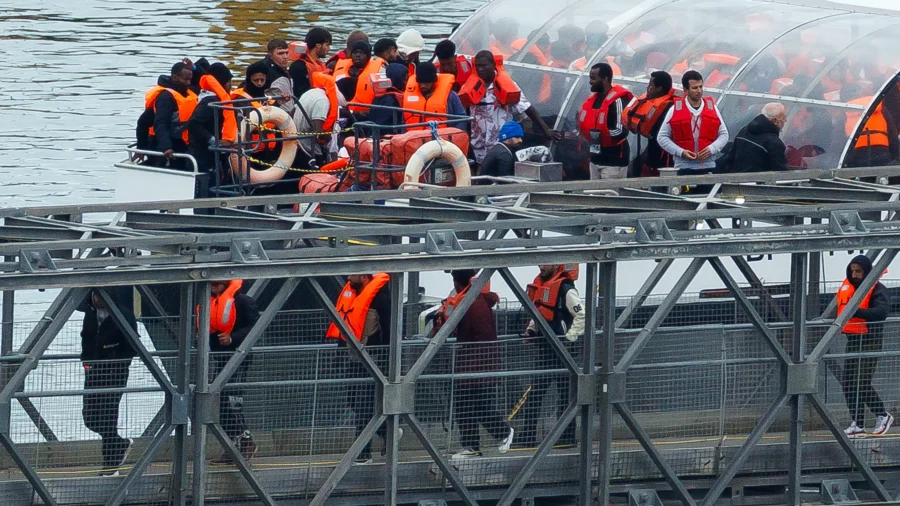
The UK has agreed to pay France up to 660 million pounds ($892 million) under a new three-year border security deal aimed at curbing illegal immigrant crossings across the English Channel.
Part of the agreed funding is contingent on whether tougher enforcement measures produce results.
The agreement, announced on April 22, deepens Anglo-French cooperation against small boat crossings. It also comes amid ongoing political pressure over migration, which has remained a central issue in British and European politics.
More than 5,000 immigrants have crossed the Channel in small boats since the start of 2026, according to the Home Office figures. That follows about 41,000 crossings in 2025, near the record set in 2022 of 45,755.
The new arrangement replaces a 480 million pound deal ($648.8 million) agreed in 2023 and increases British funding while tying a portion of payments to measurable enforcement outcomes.
“Taxpayers expect to see a return when their money is spent,” the Home Office said in an April 23 post on X. “For the first time, the funding uplift in our agreement with France will be conditional on results and reducing migrants coming to the UK.
Under the deal, about 500 million pounds ($674 million) will go toward expanded French enforcement, while another 160 million pounds ($215.8 million) will be released only if the new measures are judged effective.
Expanded Measures
The deal includes a broader French operational presence along the northern coast, where many illegal immigrant departures originate.A new 50-member riot police unit will be deployed on beaches.
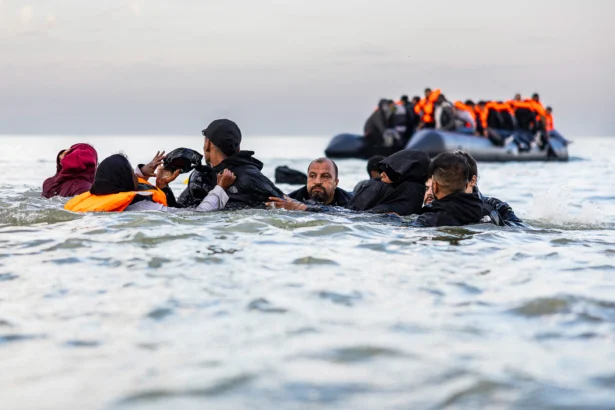
Officials also said French enforcement teams are expanding interception operations at sea, before they reach the UK.
“Specialist maritime tactics will see officers able to intercept taxi boats and return migrants to France,” said another April 23 Home Office statement posted on X.
The UK government said six illegal immigrant “taxi boats” have been intercepted in the past two months, with all illegal immigrants returned to France and five smugglers sentenced to prison and deported.
Surveillance under the agreement is also set to expand through drones, helicopters, upgraded camera systems, a new patrol vessel, and more than 20 additional maritime officers.
The government said joint work with France has already stopped more than 42,000 attempted crossings since UK Prime Minister Keir Starmer took office in July 2024.
The agreement arrives as migration remains politically sensitive in the UK, with critics questioning whether repeated funding deals have delivered sufficient reductions in crossings.
Reform UK's home affairs spokesman Zia Yusuf said in an April 23 post on X that “Tory and Labour governments have now handed a billion pounds of British taxpayer money to France to not stop the boats.”
Wider European Trends
The UK-France deal comes amid broader migration pressures across Europe.A report released this month by the Centre for Research and Analysis on Migration at RFBerlin found the number of foreign-born residents in the European Union rose to 64.2 million in 2025, up by about 2.1 million from the previous year.
Drawing on Eurostat and U.N. refugee data, the report found migration remains concentrated in a relatively small number of countries.
“Germany remains the main destination for migrants in Europe,” said Tommaso Frattini, director of the research center and professor at the University of Milan.
“The broader picture is more uneven: migration is concentrated in a small number of countries, while relative exposure varies widely across the EU.”
Spain, Italy, France, and Germany accounted for nearly three-quarters of asylum applications, according to the report.

The European Union on Jan. 29 presented a five-year strategy that aims to curb illegal arrivals, overhaul border management, and increase deportations, while creating more legal pathways for skilled workers.
The European Asylum and Migration Management Strategy, outlined in Brussels, lays out political priorities for the bloc through 2030. This includes the prevention of illegal immigration and the dismantling of criminal smuggling networks.