


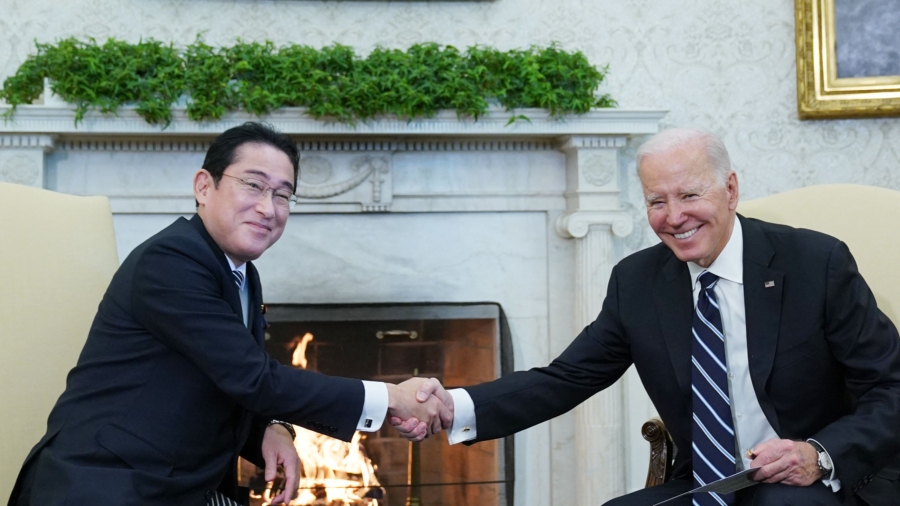
The leaders of Japan and the United States are expanding the nations’ alliance with a series of new commitments regarding defense spending, military modernization, and a new agreement that will extend their mutual defense treaty to space.
U.S. President Joe Biden welcomed Japanese Prime Minister Kishida Fumio to the White House on Jan. 13, where the two leaders agreed to the historic expansions and enhancements of their nations’ alliance.
“Rather than figuring out how we can work together, a more difficult job would be figuring out where we disagree.”
The meeting follows a flurry of activity between the two nations this week at numerous levels of government, including an overhaul in the U.S.-Japan defense posture and strategy, which will see an expansion of Japanese forces and a restructuring of U.S. Marine Corps forces stationed on and around Okinawa.
“We’re modernizing our military alliance, building on Japan’s historic increase in defense spending and new national security strategy,” Biden said.
“Let me be crystal clear. The United States is fully, thoroughly, and completely committed to the alliance.”
The move will also start talks on developing a long-range missile capability for Japanese defense forces, which have not wielded such a weapon since World War II.
Such was necessary, the leaders agreed, due to the shifting security environment and emergent threats emanating from communist China, North Korea, and Russia.
“Japan and the United States are currently facing the most challenging and complex security environment in recent history,” Kishida said.
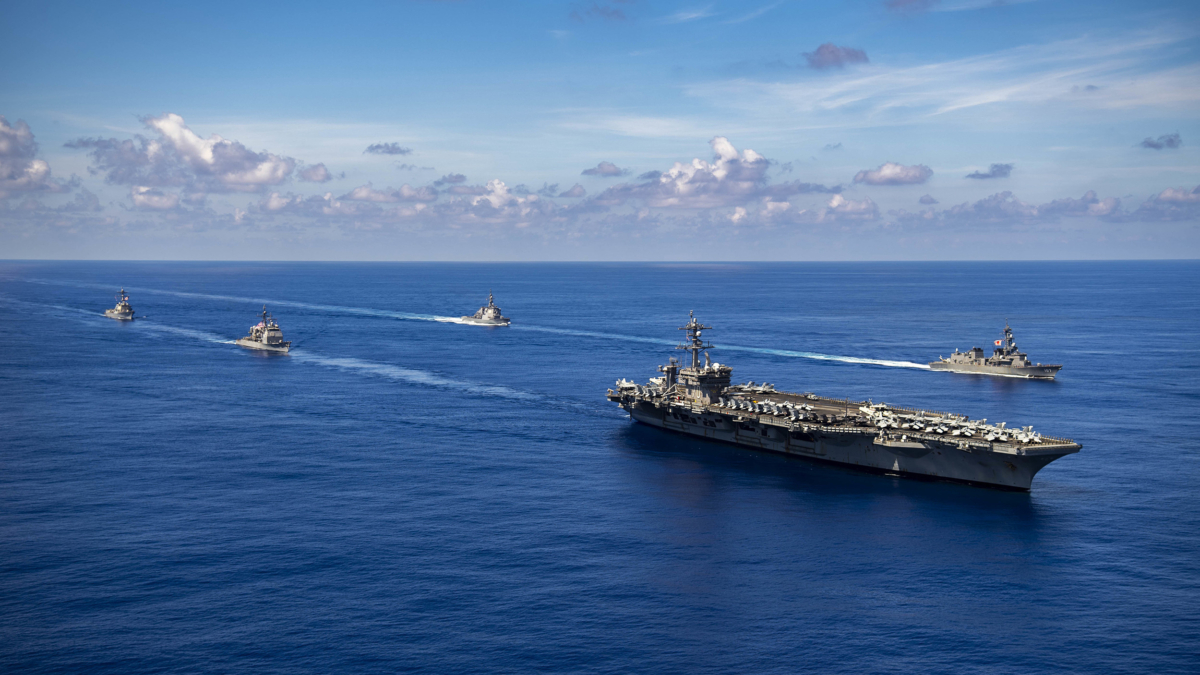
‘A Steadfast Ally’
Kishida comes to the United States after embarking on a tour of Europe in which he worked to more closely integrate Japan’s response with the West on the issue of Russia’s invasion of Ukraine and other global crises.Since the conclusion of World War II, Japan’s constitution has limited its military to an exclusive self-defense capacity, and the nation has consistently refused to pursue nuclear weapons of any kind.
The newly increased budget and assistance from the United States will now see Japan acquire conventional counterstrike capabilities designed to defend the nation from a foreign missile attack. Such long-range missiles are typically capable of striking targets about 900–1,800 miles away.
U.S. officials hailed Japan’s commitment to the alliance and the nation’s willingness to adapt to emerging threats despite long-time cultural and political precedents that render it cautious about expanding its military capabilities.
National Security Council Communications Coordinator John Kirby said that Japan is working with the United States on every facet of the effort.
“From our perspective, the message is absolutely clear: Japan is stepping up and doing so in lockstep with the United States.”
Kirby said the new agreements between Japan and the United States would meaningfully help to provide for the peace and stability of the Indo-Pacific region and deter aggression from other regional powers.
Expanding Defense In the Indo-Pacific, Space, and Beyond
Leaders from Japan and the United States capped off the busy week with the signing of a new space agreement that recognizes the two nations’ mutual interest in peaceful space exploration and use of the moon and other celestial bodies.The U.S.-Japan Space Cooperation Framework Agreement is designed to preserve and encourage the safe and responsible conduct of outer space activities in Earth’s orbit, on the moon, and beyond.
Notably, the agreement clarifies that attacks to, from, and within outer space could invoke Article 5 of the U.S.-Japan Security Treaty. This means that, should either nations’ assets or people be attacked by a foreign entity in space, the other would come to its defense.
“Space unites us,” said NASA Administrator Bill Nelson during a press conference announcing the agreement.
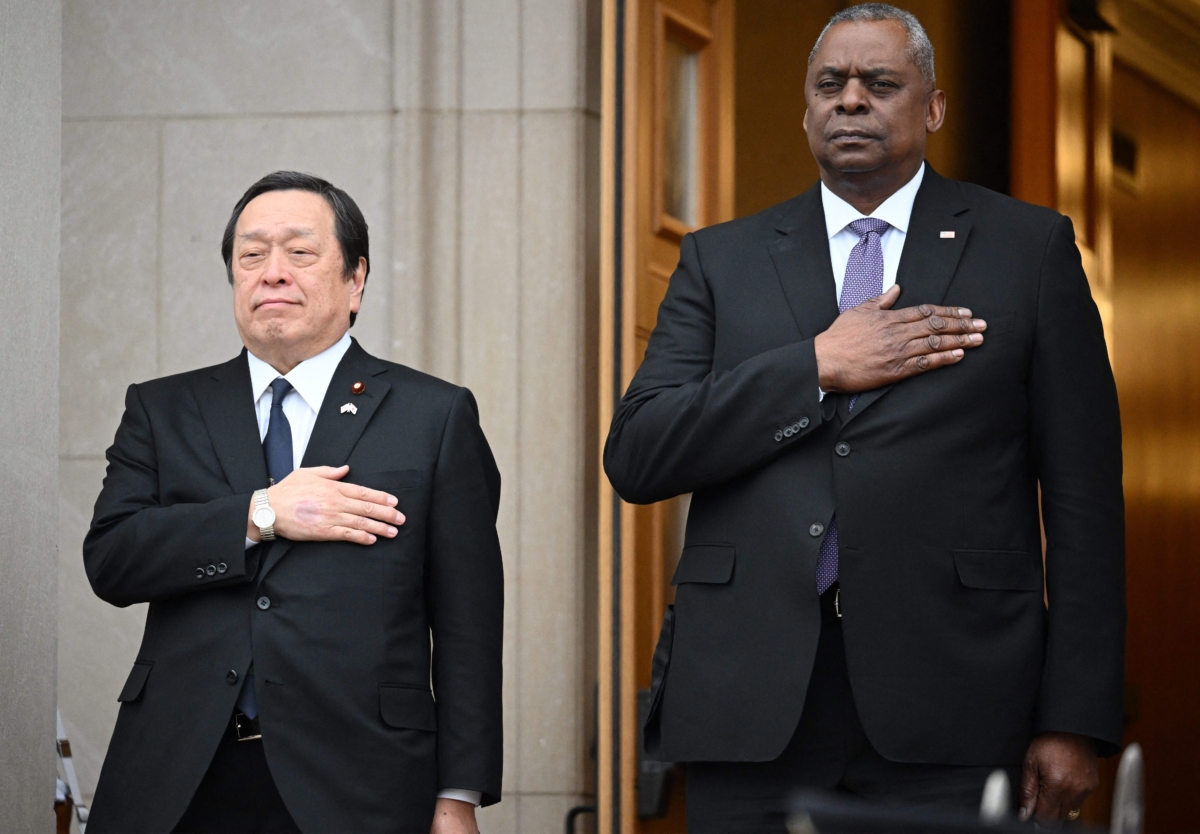
The documents commit Japan and the United States to work together on emerging defense capabilities, including autonomous systems, microwave weapons, and systems designed to counter hypersonic missiles.
“And with our shared goal of a new era of alliance modernization, I strongly support Japan’s updated national security policies, including decisions to increase defense spending [to acquire] counterstrike capabilities.”
A day prior, Austin and Hamada were joined by U.S. Secretary of State Antony Blinken and his Japanese counterpart Foreign Minister Yoshimasa Hayashi for the year’s first “2+2” meeting.
The new formation, Austin said, would be equipped with advanced intelligence, surveillance, and reconnaissance capabilities, as well as anti-ship and anti-transportation systems “relevant to the current and future threat environments.”
The meeting was hailed by National Security Council Coordinator for Indo-Pacific Affairs Kurt Campbell as an important event in the history of U.S.-Japan relations and Indo-Pacific security.
“When countries sometimes set off on these journeys, they go alone,” Campbell said. “Not Japan. They have done this in the deepest possible consultation with the United States over months of painstaking discussions, not only in the State Department but [also] a lot of interaction at the White House and the level of the prime minister’s office.”