


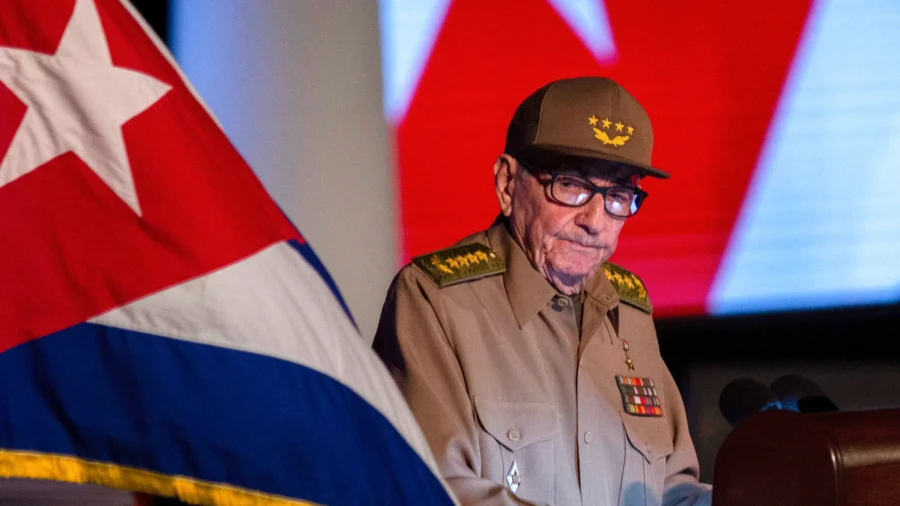
Former Cuban leader Raúl Castro has been indicted on murder charges in the United States, court records unsealed on May 20 show. The move reflects intensifying U.S. pressure on the communist regime as the island grapples with severe economic turmoil.
The charges stem from Castro’s alleged role in a 1996 incident in which Cuba shot down two planes belonging to a humanitarian group called Brothers to the Rescue, killing three U.S. citizens and one lawful resident.
The indictment, filed in federal court in Miami, charged Castro and five codefendants with one count of conspiracy to kill U.S. nationals, four counts of murder, and two counts of destruction of aircraft.
Acting U.S. Attorney General Todd Blanche and U.S. Attorney for the Southern District of Florida Jason Quiñones detailed the indictment at a news conference in Miami, home to many Cuban exiles.
“For nearly 30 years, the families of four murdered Americans have waited for justice,” Blanche said. “My message today is clear. The United States and President [Donald] Trump do not and will not forget its citizens.”
Blanche said Castro will "show up here by his own will or by another way.”
Castro, 94, is the younger brother of longtime dictator Fidel Castro. Alongside Fidel Castro and Marxist revolutionary figure Che Guevara, Raúl Castro helped lead the guerrilla warfare that overthrew dictator Fulgencio Batista in 1959.
In 2006, Raúl Castro assumed leadership of Cuba after his brother’s health began to deteriorate, and he officially became leader in 2008.
He led the country until his retirement in April 2021, when he transferred power to the current leader, Miguel Díaz-Canel.
Raúl Castro was indicted for his role in the 1996 attack on two Brothers to the Rescue civilian aircraft by Cuban MiG fighter jets.
He was the Cuban defense minister at the time.
The attack resulted in the deaths of three American citizens—Armando Alejandre Jr., Carlos Costa, and Mario de la Peña—as well as a legal U.S. resident, Pablo Morales.
The incident led to a significant diplomatic crisis between the United States and Cuba during U.S. President Bill Clinton’s administration.
Soon after, Congress passed the Helms-Burton Act, which reinforced and codified the long-standing U.S. economic embargo against the island.
“For 30 years, the families have waited, the Miami community has waited, and our country has waited,” Quiñones said at the news conference. “This is the first time in almost 70 years that … senior leadership of the Cuban regime has been charged in the United States for acts of violence resulting in the death of Americans.”
A group of U.S. lawmakers—led by Rep. Mario Díaz-Balart (R-Fla.), a Cuban American—sent a letter to U.S. President Donald Trump dated Feb. 13 calling for Raúl Castro's indictment.
“It is our understanding, based on public information, that on Feb. 24, 1996, Raul Castro ordered a Cuban Mig fighter jet to engage and obliterate two Brothers to the Rescue civilian aircraft over international waters,” the letter states.
‘New Golden Age’ for Cuba
The indictment of Raúl Castro coincided with Cuban Independence Day, which marks the official birth of the Republic of Cuba on May 20, 1902, following centuries of Spanish rule.Trump issued a statement marking Cuban Independence Day and promised “a new Golden Age for the island and its people.”
“America will not tolerate a rogue state harboring hostile foreign military, intelligence and terror operations just 90 miles from the American homeland, and we will not rest until the people of Cuba once again have the freedom their forefathers fought so valiantly to establish over 100 years ago,” Trump said.
U.S. Secretary of State Marco Rubio also shared a lengthy video message, addressing Cubans in Spanish. He asked Cubans to reject the communist regime that ruled the island for 67 years.
“We in the [United States] are offering to help you not only alleviate the current crisis, but also to build a better future,” Rubio said in his Independence Day message. “The real reason you don't have electricity, fuel, or food is because those who control your country have plundered billions of dollars, but nothing has been used to help the people.”
Fidel Castro’s Daughter Welcomes Indictment
Alina Fernández Revuelta, daughter of Fidel Castro, welcomed the charges against her uncle.“The charges increase pressure on a regime untouchable for decades,” she told The Epoch Times in a text message. “Coming from a family directly connected to that history, you understand the weight of this moment in a different way.”
Fernández Revuelta has been a strong critic of her father and his communist regime in Cuba. She fled Havana in 1993 at age 37 and settled in Miami, joining the Cuban exile community.
Fernández Revuelta said the charges against her uncle are not about revenge.
Brothers to the Rescue Incident
Brothers to the Rescue was founded in 1991 by Cuban exile José Basulto as a nonprofit group of volunteer pilots. Their main goal was to fly over the ocean to spot Cuban rafters, who were escaping political repression and economic hardships, and help the U.S. Coast Guard rescue them.During the 1994 Cuban rafter crisis, tens of thousands of Cubans fled the island for Florida by boat and raft. These individuals were commonly known as balseros, or rafters.
During their humanitarian mission, those in Brothers to the Rescue also began engaging in political activism. They flew closer to Cuba and occasionally entered Cuban airspace to drop anti-Fidel Castro leaflets over Havana.
On Feb. 24, 1996, three unarmed Cessna 337 Skymaster planes belonging to the group departed from Florida for another humanitarian mission. In response, the Cuban military sent MiG-29 and MiG-23 fighter jets to intercept them.
Two of the planes were shot down, but the lead plane, flown by Basulto, managed to avoid the attack and made it back safely to Miami.
An audio recording obtained by The Miami Herald, made just weeks after the shooting, captures Raúl Castro discussing his orders to shoot down the Brothers to the Rescue aircraft. In the recording, Castro says, “I told them [the Cuban MiG pilots] to try to knock them down over [Cuban] territory,” and “Knock them down into the sea when they reappear.”
After the incident, the Cuban communist leaders said the planes were shot down inside Cuban territorial waters, within the 12-mile coastal limit, and argued that the flights threatened the country’s sovereignty.
But an independent investigation by the International Civil Aviation Organization later found that the two planes were shot down in international airspace, well beyond the 12-mile limit. The report also states that Cuba did not give standard visual warnings before using lethal force.
The incident effectively ended the Clinton administration’s efforts to improve diplomatic relations with Havana.