


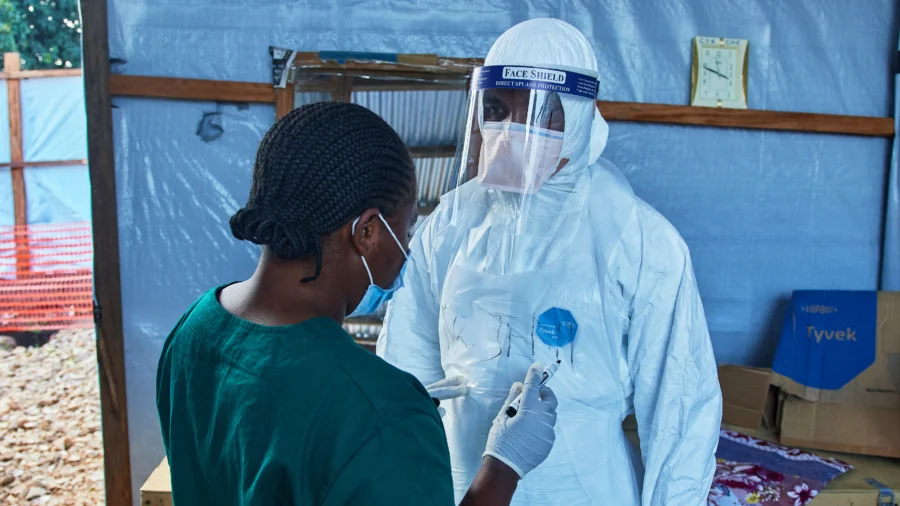
An American citizen has Ebola, the U.S. Centers for Disease Control and Prevention said on July 10.
“CDC is aware of a U.S. citizen working for a humanitarian organization in the Democratic Republic of the Congo (DRC) who has tested positive for Bundibugyo virus, a type of Ebola,” the public health organization said in a brief statement.
“CDC is working with the patient’s employing organization, other U.S. federal agencies, public health authorities, and partners in DRC to help prevent further transmission by supporting contact tracing and performing risk assessments to identify high-risk contacts,” the CDC added.
Details such as the name of the humanitarian organization for which the person works, the person’s condition, and whether they will remain in Congo have not been disclosed.
The CDC and the U.S. State Department did not immediately respond to requests for more information.
The outbreak of Ebola caused by the Bundibugyo virus was detected in May and believed to have started weeks or months earlier. The number of cases in Congo reached 1,830, with 648 deaths, authorities in the central African country said on July 10.
Twenty confirmed cases and two confirmed deaths have been recorded in Uganda, which shares a border with Congo.
An American doctor, Dr. Peter Stafford, working for the Christian nonprofit Serge earlier in the outbreak, tested positive and suffered symptoms. He was flown to Germany for treatment and has since recovered.
Stafford’s family members and another doctor working for Serge were exposed and flown to Europe for monitoring, but never tested positive.
U.S. authorities had a plan to develop a quarantine center in Kenya for Americans exposed to Ebola during the outbreak, but shelved that plan after a Kenyan court ordered officials to stop construction of the center.
The United States has multiple quarantine and isolation facilities for infectious diseases, two of which were utilized this year for people flown from a cruise ship on which a hantavirus outbreak occurred.
“We’re not ruling out moving people out to the United States if we believe that case requires more intensive management,” he said at the time.