


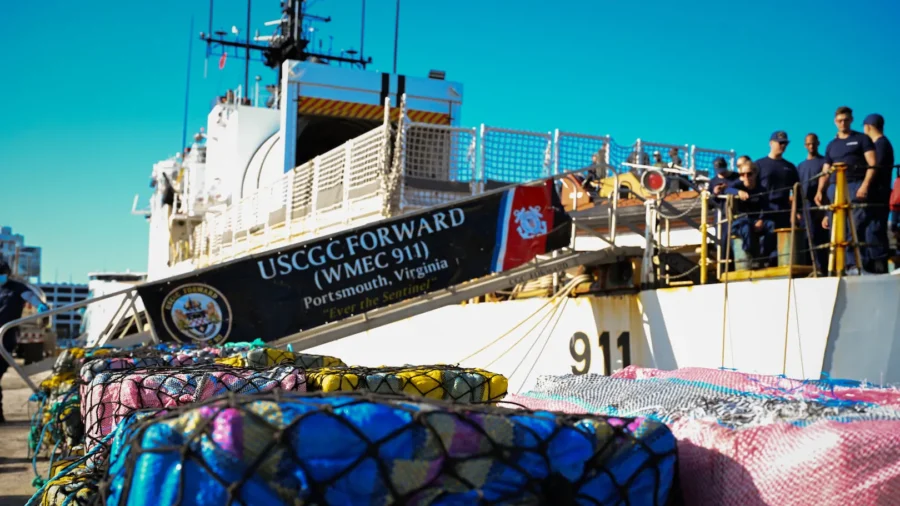
A U.S. Coast Guard vessel offloaded nearly 6,570 pounds of cocaine worth more than $49.3 million at Port Everglades, Florida, according to a March 19 statement from the federal agency.
The Coast Guard Cutter (CGC) Forward’s crew offloaded the narcotics, which were seized in two interdictions in international waters of the Eastern Pacific Ocean.
“$49.3 million worth of narcotics will never reach our streets,” the Coast Guard said in a March 20 post on X, adding that the interdictions were carried out by the crews of the CGC Forward and CGC Spencer. “This is #OpPacificViper in action: disrupting narco-terrorism that threatens our communities and keeping these deadly drugs from crossing our borders.”
On Feb. 7, about 6,435 pounds of cocaine was seized by CGC Spencer after a maritime patrol aircraft located a suspicious vessel and intercepted it with assistance from the Spencer's aircrew, which disabled the vessel.
On March 8, another suspicious vessel was located by CGC Forward’s aircrew, who deployed “use-of-force tactics” to disable it. This interdiction resulted in the recovery of about 130 pounds of cocaine.
“I'm incredibly proud of the crew for adding to the success of Operation Pacific Viper,” said Cmdr. Andrew Grantham, the Forward’s commanding officer. “The Coast Guard and our partners are working tirelessly to stop narco-terrorists and criminal organizations before their dangerous and illegal cargos reach American shores.”
The actions were part of Operation Pacific Viper, which was launched in August 2025.
Since the launch of the operation, more than 200,000 pounds of cocaine have been seized by the Coast Guard, and 150 suspected drug smugglers have been apprehended.
About 80 percent of interdictions of U.S.-bound drugs occur at sea, underscoring the importance of maritime interdiction, according to the Coast Guard.
Historic Capture of Drugs
On March 13, the Coast Guard announced that about 17,600 pounds of cocaine were taken into custody. According to the report, this quantity was large enough to make more than 6 million potentially lethal doses.The CGC Forward interdicted the drug-smuggling self-propelled semi-submersible (SPSS) watercraft on Feb. 24 in the Eastern Pacific during a routine patrol. The vessel sank after its four crew members were apprehended.
“SPSS vessels are commonly used by maritime criminal networks to transport large quantities of drugs in the Eastern Pacific. The Coast Guard routinely interdicts these vessels as part of ongoing counterdrug operations in the region,” the Coast Guard said in a March 11 statement.
On March 14, CGC Munro returned to California shores following the “single largest maritime drug seizure in 18 years,” according to an official X post.
After a 26,000-mile patrol lasting 119 days, the Munro crew had interdicted more than 22,000 pounds of cocaine worth an estimated $250 million.
“The service, our nation and our families can be extremely proud of Munro,” Capt. Jim O’Mara, the Munro’s commanding officer, said in a statement.
“This crew rose to every new challenge thrown at them with professionalism and persistence, and they achieved historic results. This was a one-of-a-kind deployment for us, but it is also just one part of a much broader campaign and U.S. national strategy.
“We could not have done this without support from partners, allies, and our families. Our families had to adapt to each new twist, just like all military families do across the Armed Forces. It is tough on them. But when they hold strong at home that keeps us motivated and focused on our mission. Now, we reunite with our loved ones, proud of what we accomplished and already preparing for the next mission.”
The interdictions deny criminal organizations illicit revenue. The shipments of cocaine and other bulk illicit drugs transported by sea enable cartels and other transnational criminal organizations to produce and traffic illegal fentanyl, threatening the United States, the Coast Guard said.