


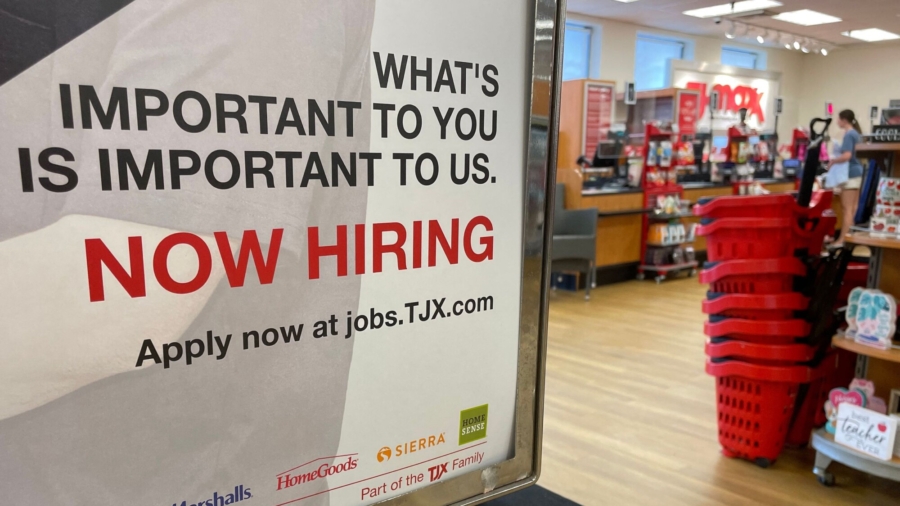
The U.S. economy added 390,000 jobs in May, topping the market estimate of 328,000.
Average hourly earnings edged up 0.3 percent month-over-month, while annualized hourly early earnings increased by 5.2 percent. Average weekly hours stayed the same at 34.6. The labor force participation rate rose to 62.3 percent.
Economists had forecast that job growth would slow to a 13-month low last month.
Last month, retail trade fell by 61,000 jobs, with most of the employment declines led by merchandise stores (-33,000), apparel (-9,000), building material and garden supply stores (-7,000), and health and personal care outlets (-5,000).
Employment in leisure and hospitality rose by 84,000, led by food services (+46,000) and accommodation (+21,000). This is still 7.9 percent below February 2020 levels.
Business and professional services increased by 75,000, but this is 821,000 higher than before the coronavirus pandemic.
Transportation and warehousing jobs added 47,000 jobs, which is 709,000 positions above its pre-crisis level. Construction jobs jumped by 36,000. Manufacturing positions rose 18,000, while mining employment swelled by 6,000. Wholesale trade gained 14,000 jobs.
According to ADP, the services sector added most of the jobs with 104,000, led by education and healthcare (46,000) and professional and business services (23,000). The goods-producing industries created 24,000 new positions as manufacturing was at the top with 22,000).
Large- and mid-sized companies added 122,000 and 97,000 jobs, respectively. But small companies lost 91,000 positions. In total, smaller U.S. firms have lost close to 300,000 jobs since February.
“Under a backdrop of a tight labor market and elevated inflation, monthly job gains are closer to pre-pandemic levels. The job growth rate of hiring has tempered across all industries, while small businesses remain a source of concern as they struggle to keep up with larger firms that have been booming as of late," said Nela Richardson, the chief economist at ADP, in a statement.
The number of Americans submitting their resignation letters also tumbled to 4.424 million in April, down from 4.449 million in March. The quits rate held steady at 2.9 percent.
Will the Fed Kill Jobs?
In recent months, the debate unfolding in economic circles and on Wall Street is if the Federal Reserve's monetary policy tightening will cripple the U.S. economy.Now that the central bank is on a path of raising the neutral Fed funds rate to around 2.5 percent by the end of the year, many economists question if this will douse the red-hot labor market and derail growth.
Typically, when interest rates are on an upward trajectory, consumer spending and business investments take a hit. This inevitably leads to a reduction in hiring and a jump in unemployment.
"We will go until we feel we’re at a place where we can say financial conditions are in an appropriate place, we see inflation coming down. We’ll go to that point. There won’t be any hesitation about that," Powell said. "You’d still have a strong labor market if unemployment were to move up a few ticks. I would say there are a number of plausible paths to have a soft as I said softish landing. Our job isn’t to handicap the odds, it’s to try to achieve that.”
Other Fed officials agree with this assessment, including Fed Governor Christopher Waller.
“The unemployment rate will increase, but only somewhat because labor demand is still strong—just not as strong—and because when the labor market is very tight, as it is now, vacancies generate relatively few hires,” Waller stated. “Thus, reducing vacancies from an extremely high level to a lower—but still strong—level has a relatively limited effect on hiring and on unemployment.”
A potentially weakening labor market is unlikely to dissuade the Fed hawks from slowing down aggressive tightening efforts, says Ipek Ozkardeskaya, a senior analyst at Swissquote Bank.
"So, the Fed will certainly not change its mind on the soft jobs data," she wrote in a research note. "Fed Vice Chair Lael Brainard has been clear that the Fed is unlikely to stop raising rates after the two 50bp hikes expected in the next two FOMC meetings. The era when the Fed threw money to the market to boost jobs is behind. We are in a new era, the era of high inflation, and the soft jobs will hardly stop the Fed from hiking the rates."
The rate-setting Federal Open Market Committee (FOMC) will meet later this month. It is widely anticipated that the central bank will pull the trigger on another half-point increase.