


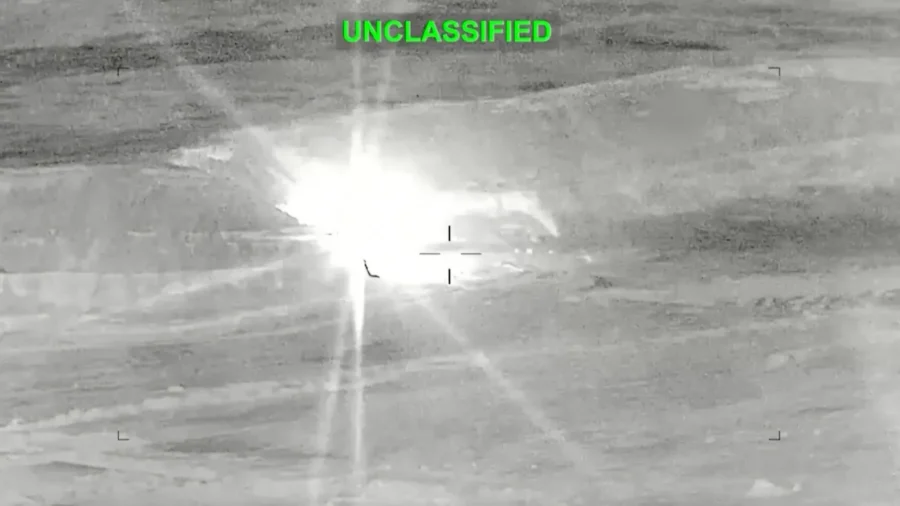
U.S. forces launched a new set of strikes on Iranian military targets on June 27, as back-and-forth exchanges test the resilience of a peace framework adopted by both countries last week.
“United States aircraft just struck Iranian missile and drone storage locations, and coastal radar sites, for violating the Cease Fire Agreement, AGAIN!” President Donald Trump wrote in a Truth Social post.
“It is very possible that they will never learn! There may come a point when we are no longer able to be reasonable, and will be forced to militarily complete the job that we very successfully started. If that happens, the Islamic Republic of Iran will no longer exist!”
In a statement, the U.S. Central Command (CENTCOM) announced U.S. forces targeted Iranian air defenses, drone storage facilities, minelaying capabilities, communications systems, and surveillance infrastructure in a wave of strikes on Saturday.
The U.S. strikes on Iran on Saturday are part of a series of back-and-forth exchanges that have played out in recent days.
Iran’s Islamic Revolutionary Guard Corps (IRGC) launched another round of drones and missiles toward Bahrain and Kuwait on Sunday. It threatened a “complete halt” to negotiations to end the war if Washington continued its attacks.
Kuwait’s Foreign Ministry condemned the IRGC attack in a statement.
“The Ministry of Foreign Affairs expresses the State of Kuwait's condemnation and strongest denunciation of the repeated heinous Iranian aggressions against the State of Kuwait, the latest of which occurred at dawn today, in flagrant violation of its sovereignty, a direct threat to its security and stability, and the safety of its citizens and residents on its territory, and a clear breach of the rules of international law and the United Nations Charter,” it said.
It added that Iran’s ongoing aggression amid the peace talks aimed at de-escalation “constitutes an undermining of initiatives designed to reduce tensions in the region and represents a direct challenge to the international will supporting this path.”
Tensions have been building in the region after an explosive one-way attack drone struck Singapore-flagged cargo ship M/V Ever Lovely on June 25. The U.S. government attributed that attack to Iran, and responded on June 26 with a wave of strikes inside Iran.
“After yesterday’s U.S. strikes in response to the Iranian attack on M/V Ever Lovely, Iran was given a chance to honor the ceasefire agreement but elected not to when its forces launched a one-way attack drone that hit M/T Kiku this morning at 4:30 a.m. ET,” CENTCOM said on Saturday. The M/T Kiku is a Panamanian-flagged oil tanker.
Iran’s IRGC also claimed responsibility for attacks on U.S. military targets in the region, in retaliation for the U.S. strikes on Iran on June 26.
These new exchanges of fire occurred amid continuing disputes over a long-term peace framework for the region.
On June 17, the United States and Iran enacted a 14-point memorandum of understanding aimed at resolving the large-scale armed conflict that began between the two countries when U.S. and Israeli forces began striking Iran on Feb. 28.
The June 17 memorandum called for an immediate cessation of hostilities across the region, including the Israeli military campaign in Lebanon against the Iran-aligned internationally-designated terrorist group Hezbollah.
Disputes are also continuing over control of the Strait of Hormuz, a key maritime chokepoint for international petrochemical exports.
Iranian forces moved to close off access to the Strait of Hormuz after the fighting began on Feb. 28.
The June 17 memorandum of understanding called for Iran to facilitate “the safe passage of commercial vessels with no charge” through the Strait of Hormuz for 60 days, to allow for further negotiations. The peace framework said Iran and Oman, which sit on opposite sides of the maritime chokepoint, are to coordinate on a long-term method for administering traffic in the Strait, in consultation with the neighboring states.
This week, Iran’s Islamic Revolutionary Guard Corps warned that vessels transiting the Strait of Hormuz must only use routes officially designated by Iran. The Iranian military arm said it was prompted to issue this advisory in response to reports that a new shipping lane was launched without prior consultation with Tehran.