


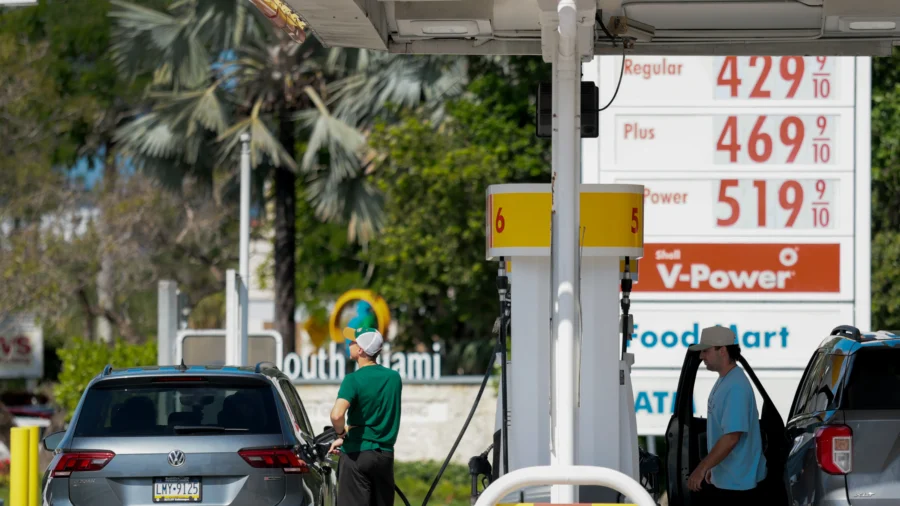
The average price for a gallon of gasoline hit its highest level in four years on Tuesday as the cost of a barrel of oil remains elevated amid the conflict with Iran, according to a prominent analyst.
The national average price for a gallon of gas was $4.17, “the highest level since 2022,” and surpassed the $4.16 price reported earlier this month, said GasBuddy analyst Patrick de Haan in an X post on April 28.
“We’ll continue to head higher for now,” he added.
The American Automobile Association (AAA) also said the price for a gallon of regular gas reached just above $4.17, showing a 6-cent increase from Monday.
The price of gas and oil surged after the United States and Israel launched strikes on Iran on Feb. 28, prompting the country to respond by attacking ships in the Strait of Hormuz and launching its own strikes on neighboring countries in the Middle East.
Diesel was significantly higher on Tuesday, with AAA showing the price for a gallon at $5.46, an increase of 2 cents over Monday’s average.
According to an AAA report in March, the nationwide average price for a gallon of gas stood at around $2.98 on Feb. 26, two days before the U.S. military launched the strikes.
A federal Energy Information Administration (EIA) graph shows that gas prices reached $4.21 per gallon in April 2022, several weeks after Russia invaded Ukraine in February 2022.
Prices may have been impacted by the United Arab Emirates’ announcement on Tuesday that the oil-rich country was quitting the Organization of the Petroleum Exporting Countries (OPEC), dealing a blow to the oil producers’ group. The exit of the UAE weakens OPEC’s control over global oil supplies and will widen a rift between the UAE and neighboring Saudi Arabia.
UAE Energy Minister Suhail Mohamed al-Mazrouei told Reuters in a telephone interview that the decision was taken after examining the country’s energy strategies. He said the UAE had not discussed the issue with any other country.
“This is a policy decision, it has been done after a careful look at current and future policies related to level of production,” al-Mazrouei said.
OPEC Gulf producers have been struggling to ship exports through the Strait of Hormuz, a chokepoint between Iran and Oman through which roughly a fifth of the world’s crude oil and liquefied natural gas normally passes, due to Iranian threats and attacks on vessels. The Trump administration has pushed for Iran to reopen the strait while maintaining a U.S. naval blockade on Iran’s ports.
Earlier on April 28, an Iranian military official told the semi-official IRNA news agency that Tehran considers itself still at war with the United States amid the blockade and ceasefire.