


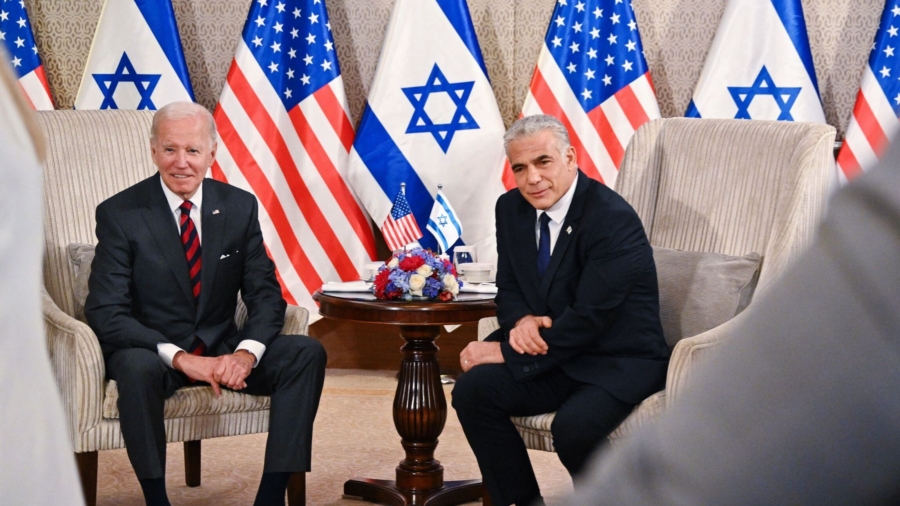
President Joe Biden and Israeli Prime Minister Yair Lapid signed a new joint declaration expanding the security relationship between the United States and Israel on Thursday.
A senior White House official told reporters on a conference call that the pledge will include reaffirming a commitment to block Iran from acquiring nuclear weapons.
"This declaration is pretty significant, and it includes a commitment to never allow Iran to acquire a nuclear weapon and to address Iran’s destabilizing activities, particularly threats to Israel," the senior White House official said.
The joint pledge will also note the United States' and Israel's ongoing support for a memorandum of understanding that was finalized when Biden was vice president under former President Barrack Obama.
"The declaration will also emphasize support for the Abraham Accords and expanding Israel’s integration into the region, which of course is a theme of this trip," the senior White House official said.
Iran Nuclear Deal
In an interview with Israeli media, which was recorded before he left Washington on Tuesday but aired on Wednesday, Biden said he would keep Iran's Islamic Revolutionary Guard Corps (IRGC) on the U.S. Foreign Terrorist Organizations (FTO) list even if that killed off the 2015 Iran nuclear deal as he began a trip to the Middle East.Asked if his past statements that he would prevent Tehran from obtaining a nuclear weapon meant he would use force against Iran, Biden replied: "If that was the last resort, yes."
Biden's 1st Visit to Middle East as President
Biden arrived in Israel on Wednesday on his first Middle East trip as president, but his 10th overall.At the airport, Biden was briefed by Israeli Defense Minister Benny Gantz on Israel's Iron Dome defense system and a new technology called Iron Beam, which uses lasers and is being developed in conjunction with the U.S. Missile Defense Agency.
The United States has provided Israel with $4.8 billion for its security, which includes $1 billion for replenishing Iron Dome after the May 2021 conflict with Hamas in Gaza.
The president later laid a wreath at the Yad Vashem Holocaust memorial and met with Holocaust survivors.
On Thursday, Biden met with Lapid for a bilateral meeting ahead of the announcement of the joint declaration. He is then scheduled to meet with Israeli President Isaac Herzog at his residence to discuss Herzog's recent visits to Jordan, Turkey, and United Arab Emirates (UAE).
The two countries will also launch a new high-level strategic dialogue on technology in a bid to boost cooperation in four key areas. The four fields are technology to help with future pandemic preparedness, using technology to affect the climate, "artificial technology," and "other trusted technology ecosystems."
"We want their tech sector to be connected with ours and looking west as we look to build the technology apparatus for the future," the senior White House official said.
East Jerusalem Controversy
On Friday, the president will visit the West Bank and East Jerusalem, and announce Palestinian economic opportunities, including the development of 4G capabilities, both in Gaza and the West Bank.On Wednesday, White House spokesperson John Kirby had to walk back remarks made by U.S. National Security Adviser Jake Sullivan to reporters on Air Force One after he said that the Biden administration wants the Palestinians to have a consulate in East Jerusalem.