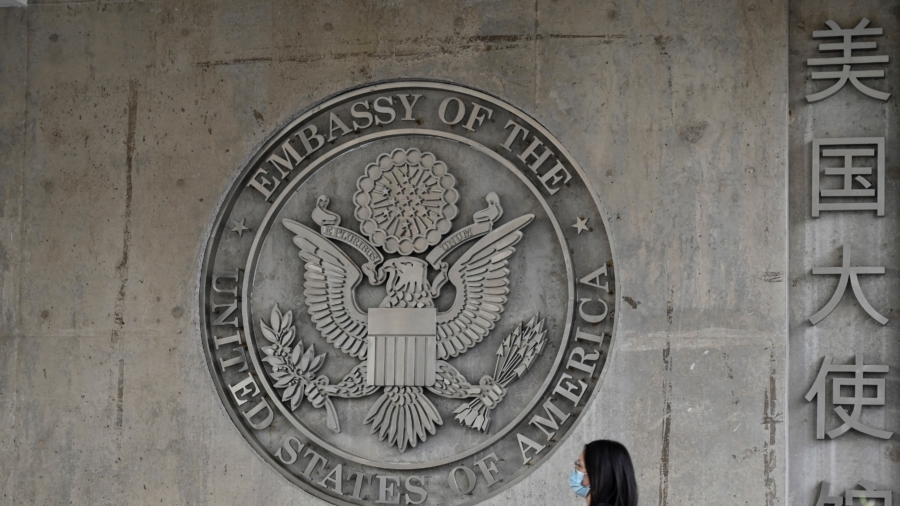
The U.S. Embassy in China has issued rare warnings for three consecutive days, urging American citizens to be on heightened alert when traveling to or remaining in the country.
The embassy advised that U.S. nationals should remain vigilant regarding judicial measures employed by Chinese Communist Party (CCP) authorities, including arbitrary detention and the use of exit bans against individuals with certain backgrounds.
The warnings followed China’s confirmation last Friday that it had detained a U.S. citizen.
China’s Ministry of Foreign Affairs said that Min Zin, a Burmese-American scholar who traveled to Kunming for a conference, had been placed under “criminal compulsory measures” on suspicion of espionage and activities endangering national security.
“The Department of State has no higher priority than the safety and security of Americans,” a State Department spokesperson said in a
statement to The Epoch Times. “Whenever a U.S. citizen is detained, we work to provide appropriate consular assistance.”
On June 15, the U.S. Embassy in China issued a
bilingual warning noting that Chinese authorities may target U.S. citizens of Chinese descent or those with ties to U.S. government, public, or private-sector institutions.
A day earlier, the
embassy cautioned that China may arbitrarily enforce local laws, potentially resulting in “detention, arrest, or exit bans”. It added that travel restrictions may be imposed without a “clear or transparent legal process” for resolution.
In a
separate notice two days prior, the embassy emphasized that China does not recognize dual citizenship. It warned that individuals entering China using Chinese travel documents or holding Chinese identification—such as a national ID card or household registration (hukou)—may be denied U.S. consular assistance in cases involving detention or exit bans.
On June 15, Rep. John Moolenaar (R-Mich.), chairman of the House Select Committee on the CCP,
called for Min Zin’s immediate release, describing the detention as unjustified and urging American companies “should take note that this is how China treats innocent Americans and stop any work they are doing that supports China's military and oppressive surveillance state.”
Exit Bans and 'Hostage Diplomacy'
The use of exit bans has been exercised for years as a tool employed by the CCP. Those affected are often individuals of Chinese descent, including former Chinese citizens, though others have also been targeted.
A May 2023
report by the human rights organization Safeguard Defenders found that the use of exit bans has expanded under Chinese leader Xi Jinping, describing them as part of broader efforts to tighten state control over society.
The report indicated that targets have included human rights advocates, ethnic and religious minorities, foreign journalists, and international business executives.
In July last year, Chenyue Mao, a Shanghai-born U.S. citizen and banker based in Atlanta, was subjected to an exit ban while in China. The case reportedly led her employer, Wells Fargo, to suspend employee travel to the country. Mao was later allowed to return to the United States following months of diplomatic negotiations.
In a separate incident, an employee of the U.S. Department of Commerce was detained and questioned during a family visit to southwestern China, reportedly in connection with prior U.S. military service.
Analysts say such detentions are often framed as espionage or economic crimes but lack transparency. Yeh Yao-Yuan, a political science professor at the University of St. Thomas, told
The Epoch Times that such cases are frequently used for diplomatic leverage, describing the practice as a form of “hostage diplomacy.”
In 2024, the Congressional-Executive Commission on China (CECC) held a hearing titled “Bringing Home Americans Detained in China,”
noting that more Americans are detained in China than in any other country.
Peter Humphrey, a former detainee who now assists affected families, has estimated that as many as 300 Americans in China may be subject to detention, imprisonment, or movement restrictions.
"None of them has received a fair and transparent trial," he
said.