


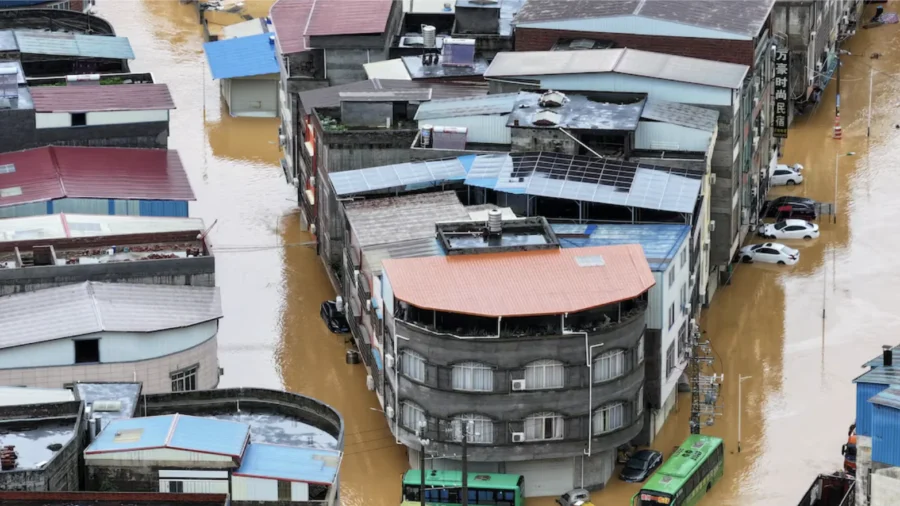
A series of catastrophic dam failures and reservoir overtoppings has left an estimated 170,000 people under imminent threat in southern China, after the remnants of Typhoon Maysak triggered days of torrential rainfall.
According to local authorities in Hengzhou City on July 6, part of the wider Nanning region in Guangxi province, multiple reservoirs breached or spilled over their banks on Saturday morning following what has been described as a "big deluge."
The local emergency response was upgraded to Level I—the highest possible alert status—as rescue teams tried to reach what local residents describe as looking like "an open sea."
The crisis escalated rapidly on Monday when the dam body at the Liulan Reservoir—the largest medium-sized reservoir in the area—suffered two partial collapses.
The reservoir holds a total capacity of over 93 million cubic meters of water and serves as a vital irrigation source for nearly 25,000 acres of farmland.
Villages Swallowed Whole
Downstream, the impact was immediate and devastating. Some villages have almost been inundated entirely, with floodwaters reaching the roofs of single-story homes and commercial warehouses."The flooding hit so fast; people simply couldn't get out," said a resident from Dengxu Village in the hard-hit town of Yunbiao. "The water was too deep and rushing too fast. Everyone is trapped on the second floors of their houses. We are running out of food and supplies, but the roads are cut off so nothing can get in."
"The reality is far worse than what the videos show," he said. "Local internet and power are completely down, and I have lost all contact with my family. I am certain people have been swept away."
Images from the affected areas show streets converted into raging rivers, with cars swept away and residents waiting helplessly on rooftops.
The Nanning Municipal Emergency Management Committee stated that the region had been hammered by continuous "extreme torrential rain" since Thursday, causing river levels across the province to spike to dangerous heights.
The weather emergency is far from over. Meteorological departments have warned that the residual circulation of Typhoon Maysak will continue to dump heavy rain across Guangxi through Tuesday.
The storm system is then projected to move further north, raising fears that heavily populated central and eastern provinces—including Hunan, Hubei, and Jiangsu—could be the next to face flooding.