


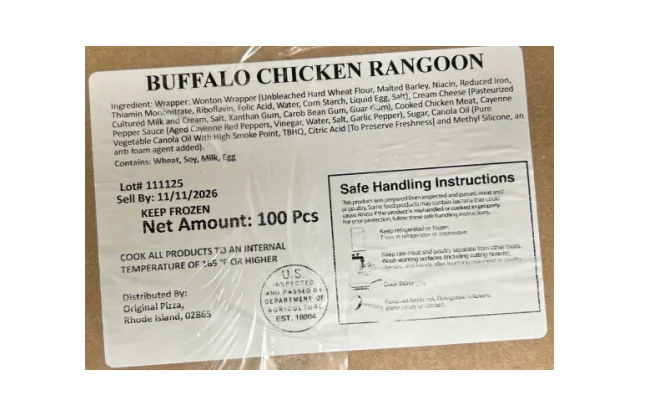
The U.S. Department of Agriculture (USDA) Food Safety and Inspection Service (FSIS) announced the recall of 24,900 pounds of raw chicken products distributed in five states.
“Food produced without inspection may contain undeclared allergens, harmful bacteria, or other contaminants that put consumer health and safety at risk,” federal officials said.
The recall is applicable to 100 pieces of Buffalo Chicken Rangoon and 120 pieces of Benedetto’s Buffalo Chicken Mozzarella Stick.
The FSIS states that the chicken was shipped to food service locations in Maine, Massachusetts, New Hampshire, Rhode Island, and Vermont with false marks of inspection under establishment number “EST. 18004.”
Authorities added that the establishment number does not have a federal grant of inspection.
“The problem was discovered during routine FSIS inspection activities,” federal officials added.
The Not Ready to Eat (NRTE) chicken was produced between July 8, 2025, and June 29, 2026, with July 8 to June 29, 2027, expiration dates.
There have been no confirmed reports of illness or injury due to consumption of these products. Federal officials urge anyone concerned about an illness or injury to contact a health care provider.
The FSIS is concerned that some products may be stored in food service refrigerators or freezers.
As a result, food service locations that have purchased these meat products are urged to throw them away or return them to the place of purchase.
Earlier in August, the FSIS announced the recall of 29,628 pounds of raw beef products distributed in Florida and Texas.
The Aug. 7 recall is applicable to various weight cardboard boxes containing FrigorIfico Gorina SAIC boneless beef Top Sirloin Butt (Cuadril Sin Tapa), Eye Round (Peceto), Topside Cap Off (Nalga AD S/Tapa), Flat (Carnaza Cuadrada), and Knuckle (Bola de Lomo).
The products subject to the recall bear Argentinian establishment number “EST. N° OF. 2025” and shipping mark “26644-AA.”
While these meat products should be thrown away or returned to the place of purchase, there have been no confirmed reports of illness or injury due to consumption of the beef, according to federal officials.
However, anyone concerned about an illness or injury should contact a health care provider.