


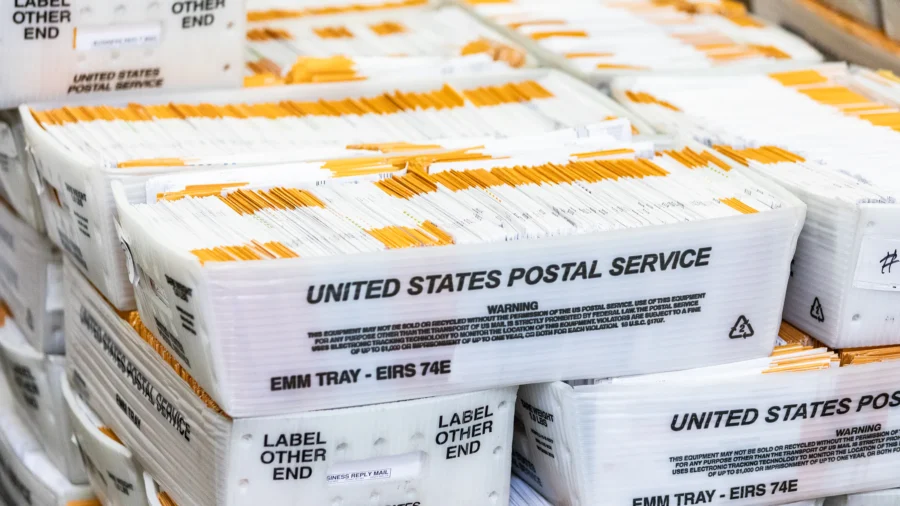
The U.S. Postal Service (USPS) has published new rules that would require states that use the agency for mail-in voting in federal elections to first submit lists of voters who receive mailed ballots—if the court injunctions blocking such rules are lifted.
“Any state that intends to receive mail-in or absentee ballots from individual voters through the Postal Service must ensure that such individuals have been enrolled with the Postal Service for inclusion on the state's Mail-In and Absentee Participation List,” USPS said in the 95-page final rule released Friday.
To enroll an individual, state election officials would have to submit the voter’s name and address through a new online portal, along with unique “Intelligent Mail barcodes” assigned to both the outbound ballot envelope and the return ballot envelope.
Under the rule, USPS would review outbound federal ballot mailings before accepting them to determine whether they meet the new envelope standards and are being sent to voters enrolled through the Postal Service’s system.
Noncompliant outbound mailings would not be accepted and would instead be returned to the authorized ballot mailer for correction.
The rule also requires outbound federal ballot envelopes to display the official “Election Mail” logo, be compatible with postal automation equipment, and carry a unique barcode.
USPS said postal employees would not be authorized to open mail sealed against inspection, and that the agency would not collect or record voters’ party affiliations or inspect ballot contents.
Instead, it would maintain information generated from the exterior of mailpieces, including addresses and barcode data.
The regulations stem from President Donald Trump’s March 31 executive order, which, among other things, directed USPS to develop rules governing mail-in and absentee ballots used in federal elections.
It contemplated requiring states to notify USPS at least 90 days before an election if they planned to use the Postal Service for mail voting. Any notifying state would need to further indicate whether they intended to submit voter information at least 60 days before the election.
The final USPS rule, however, makes the 90-day notification optional. It also calls for states to submit voter information at least 30 days before a federal election, “to the extent practicable,” or by the date on which mail-in or absentee ballots may begin to be mailed under state law.
States would be able to continue adding or modifying entries afterward.
The rule is scheduled to be formally published in the Federal Register on Aug. 26 and lists Aug. 21 as its effective date. USPS said, however, that it will not take steps to implement the rule for the Nov. 3 midterm elections unless the court injunctions blocking the relevant provisions of Trump’s executive order are lifted.
The legal blockade stems from two cases before U.S. District Judge Indira Talwani of Massachusetts.
On June 25, Talwani sided with 23 states and the District of Columbia in their challenge to the executive order. She blocked the USPS mail-ballot provisions from taking effect in those states for federal elections through Nov. 3.
Then, on Aug. 11, Talwani issued a separate preliminary injunction in a lawsuit brought by the League of Women Voters of Massachusetts and other advocacy groups.
That order blocks USPS from enforcing the mail-ballot provisions nationwide for the Nov. 3 election and any earlier federal election. It also prevents USPS from refusing to handle mail-in or absentee ballots based on those provisions.
USPS Postmaster General David Steiner defended the rule when it was first proposed in June, arguing that the agency is simply “match[ing] the ballots that a state believes they're sending out to what actually gets sent out."
“To me, it’s not a political question; it’s a question of how do we most efficiently and securely move ballots,” Steiner said as he testified before the Senate Homeland Security and Governmental Affairs Committee about the proposed rule.
“We’ve been recommending this for many years; all this does is make it a requirement.”
USPS said on Friday that it published the final rule despite the injunctions to move quickly if the government obtains relief from the courts before the election.
“If the government obtains timely relief from the injunctions,” the agency said, immediate implementation would give election officials as much time as possible to comply with the new ballot-mail requirements before ballots begin going out.