


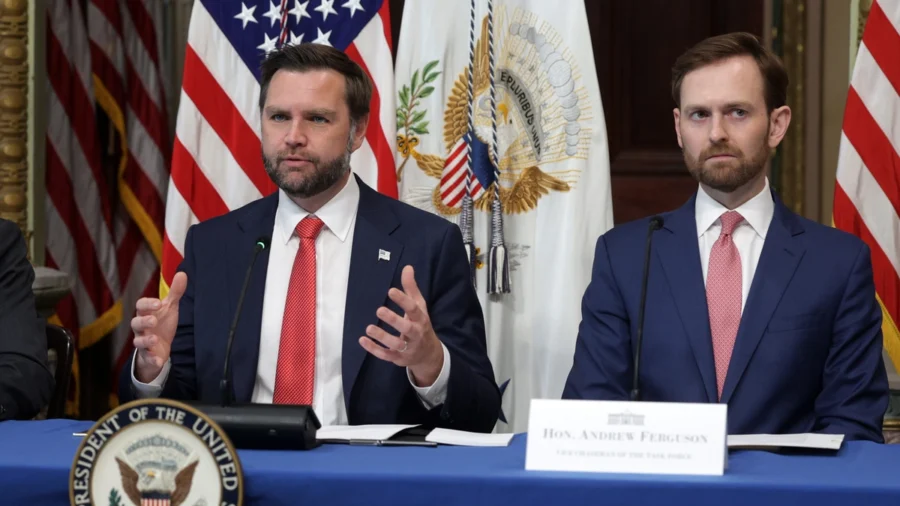
WASHINGTON—Vice President JD Vance said on Aug. 5 that the Trump administration has identified $230 billion in fraud and prevented $56 billion in fraudulent payments since the president's Fraud Task Force was established in March.
Vance discussed the task force’s initiatives at a roundtable in the Eisenhower Executive Office Building attended by more than a dozen Republican lawmakers. He said the work by the task force so far is starting to show results.
“We have been able to identify $230 billion of fraud just since the Fraud Task Force was set up, and that's frankly by conservatively estimating it,” Vance said.
He urged Congress to codify certain anti-fraud actions taken by the administration to ensure they remain in effect under future administrations.
“This effort will fundamentally always have a limitation unless our colleagues in the House and the Senate are working with us,” Vance said.
“We don't want the next administration … to undo all the incredible work that we've been doing.”
The vice president said one of the first steps Congress can take is to force data sharing between the state and the federal governments to crack down on fraud.
He argued that if a state gives food stamp benefits to an illegal immigrant or a violent criminal, the federal government often cannot detect who is receiving those benefits.
The vice president also called on Congress to make fraud harder to commit and to ensure convicted fraudsters receive longer prison sentences that better reflect the seriousness of their crimes.
On March 16, President Donald Trump signed an executive order to establish a task force after large-scale fraud in Minnesota’s Medicaid and federal assistance programs drew national attention late last year. He then appointed Vance to lead the new task force while also creating a fraud-focused division in the Justice Department.
Speaking at the event, Federal Trade Commission Chairman Andrew Ferguson, who co-chairs the task force, said that fraudsters target federal assistance programs because they are relatively easy to exploit. He noted one reason is that “the punishments associated with much of the fraud are relatively low.”
Hence, the administration wants to work with Congress to significantly increase sentences for all levels of fraud, he said, to deter potential fraudsters from targeting these programs.